


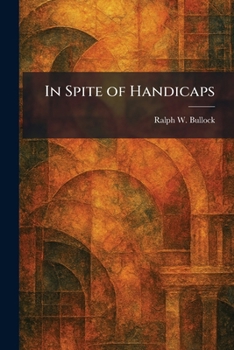
In Spite of Handicaps

Select Format
Select Condition 
Book Overview
"In Spite of Handicaps" is an inspiring collection of biographical sketches profiling the lives and achievements of prominent African American figures during the early 20th century. Written by Ralph W. Bullock, this work was designed to highlight the resilience and brilliance of individuals who triumphed over systemic barriers and social prejudices. The volume features influential leaders, artists, and innovators, documenting their personal struggles and professional milestones to illustrate their significant contributions to American society.
By detailing the narratives of figures such as Booker T. Washington, George Washington Carver, and Roland Hayes, Bullock provides a powerful testament to the strength of the human spirit and the enduring quest for equality. Each entry serves to showcase how these individuals excelled in their respective fields despite the profound racial and economic obstacles of their time. This historical work remains a vital resource for understanding the African American experience and serves as a motivational guide that emphasizes the possibility of greatness regardless of the challenges one may face. It is an essential read for those interested in the history of civil rights and the foundational stories of Black achievement in America.
This work has been selected by scholars as being culturally important, and is part of the knowledge base of civilization as we know it. This work was reproduced from the original artifact, and remains as true to the original work as possible. Therefore, you may see the original copyright references, library stamps (as most of these works have been housed in our most important libraries around the world), and other notations in the work.
This work is in the public domain in the United States of America, and possibly other nations. Within the United States, you may freely copy and distribute this work, as no entity (individual or corporate) has a copyright on the body of the work.
As a reproduction of a historical artifact, this work may contain missing or blurred pages, poor pictures, errant marks, etc. Scholars believe, and we concur, that this work is important enough to be preserved, reproduced, and made generally available to the public. We appreciate your support of the preservation process, and thank you for being an important part of keeping this knowledge alive and relevant.
Customer Reviews
ThriftBooks ® and the ThriftBooks ® logo are registered trademarks of Thrift Books Global, LLC
