


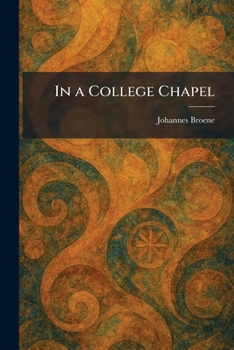
In a College Chapel

Select Format
Select Condition 
Book Overview
"In a College Chapel" is a collection of insightful addresses and reflections designed to foster the spiritual and intellectual growth of students. Johannes Broene brings a deep understanding of the unique pressures and aspirations of the academic environment, offering guidance that harmonizes faith with the pursuit of knowledge. The work emphasizes the cultivation of character, the importance of moral integrity, and the necessity of a religious foundation in the life of a scholar.
These chapel talks address a variety of themes relevant to the college experience, from the challenges of intellectual doubt to the responsibilities of leadership and service. By blending theological principles with practical wisdom, Broene provides a roadmap for young adults navigating the transition into maturity. The prose is clear and accessible, reflecting the oratorical tradition of early 20th-century religious life on campus.
For readers interested in the history of Christian higher education or the development of the chapel talk as a literary and homiletic form, "In a College Chapel" remains a significant text. It captures a specific moment in the dialogue between academia and the church, advocating for a holistic approach to education that values both the mind and the soul.
This work has been selected by scholars as being culturally important, and is part of the knowledge base of civilization as we know it. This work was reproduced from the original artifact, and remains as true to the original work as possible. Therefore, you may see the original copyright references, library stamps (as most of these works have been housed in our most important libraries around the world), and other notations in the work.
This work is in the public domain in the United States of America, and possibly other nations. Within the United States, you may freely copy and distribute this work, as no entity (individual or corporate) has a copyright on the body of the work.
As a reproduction of a historical artifact, this work may contain missing or blurred pages, poor pictures, errant marks, etc. Scholars believe, and we concur, that this work is important enough to be preserved, reproduced, and made generally available to the public. We appreciate your support of the preservation process, and thank you for being an important part of keeping this knowledge alive and relevant.
Customer Reviews
ThriftBooks ® and the ThriftBooks ® logo are registered trademarks of Thrift Books Global, LLC
