


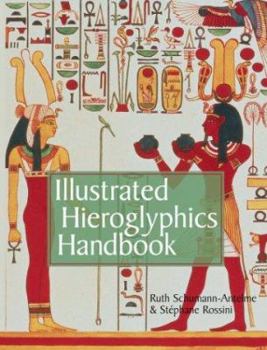
Illustrated Hieroglyphics Handbook


Select Format
Select Condition 
Book Overview
Health and social care professionals are constantly exhorted to work collaboratively. This book reports on research which examines interprofessional work with families in which mothers have a mental health problem and where there are also concerns about child protection.
Format:Paperback
Language:English
ISBN:1402700253
ISBN13:9781402700255
Release Date:June 2004
Publisher:Sterling
Length:368 Pages
Weight:1.62 lbs.
Dimensions:9.0" x 1.0" x 7.0"
Customer Reviews
1 rating
Good practice for beginners
Published by Thriftbooks.com User , 23 years ago
First off, although this is an introduction to hieroglyphs, it is NOT a grammar of Egyptian. It is an introduction to the SYMBOLS that the Egyptians used to write their language.It is an expansion of the tall, thin Dover paperback "Egyptian Hieroglyphics (How to Read and Write Them)" by Ms. Rossini that was published, in English, about 15 years ago.The book presents 26 uniliteral signs (the hieroglyph represents one consonant), over 80 biliterals (the hieroglyph represents two consonants), and about 30 triliterals (the hieroglyphic symbol represents a sequence of three consonant sounds). To oversimplify, these 3 types of symbols are the phonetic "building blocks" used to write Egyptian. For each symbol, the authors give about 4 words that incorporate the symbol in question. The pronunciation of the illustrative words is given, along with a breakdown of its elements, the definition, and a brief explanation.I'm not a big fan of learning vocabulary in isolation, but working through the book will certainly give the beginner a solid introduction to the more common symbols, and practice in recognizing how they are used to represent words. (One criticism - the use of uniliterals as phonetic complements for biliterals / triliterals is not brought up to any extent, from what I can see. But anyone serious about Egyptian will eventually use a text that makes that clear.)In sum ... a good-sized book, for a low price, that gives plenty of practice in learning and recognizing the most frequent hieroglyphs, with some cultural notes that should be of interest.Suitable for anyone over the age of (I'm guessing here) 12 or 14.
Copyright © 2026 Thriftbooks.com Terms of Use
| Privacy Policy | Do Not
Sell/Share My Personal Information | Cookie Policy | Cookie Preferences | Accessibility Statement
ThriftBooks® and the ThriftBooks® logo are registered trademarks of Thrift Books Global, LLC
ThriftBooks® and the ThriftBooks® logo are registered trademarks of Thrift Books Global, LLC
