


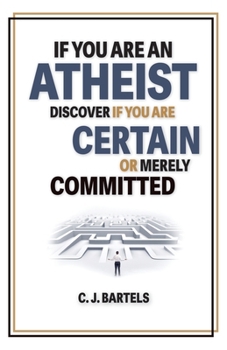
If You Are An Atheist, Discover If You Are Certain or Merely Committed

For many people, atheism appears to be the final intellectual destination: the point where superstition has been discarded, religion has been outgrown, and reason alone stands as the highest authority. It presents itself as the mature conclusion of human thought-the place one arrives after setting aside comforting beliefs in favor of evidence and rational inquiry. Yet for countless others-scientists, philosophers, historians, former atheists, agnostics, and even lifelong Christians seeking a firmer foundation for their faith-that destination proved to be only another beginning. Rather than providing satisfying answers, atheism became a question mark. In many cases, it was abandoned not because of religious pressure, but because it no longer explained reality as completely or coherently as it claimed.
This book is written for anyone who has wrestled honestly with the question of God's existence. Whether you identify as an atheist convinced there is no Creator, an agnostic who remains uncertain, a skeptic still weighing the evidence, or a Christian who desires greater confidence that faith in an intelligent Creator is grounded in reason as well as conviction, the goal is the same: to pursue truth wherever it leads.
The chapters that follow examine the principal arguments offered against belief in God, along with the evidence and reasoning that have led many thoughtful people to conclude that an intelligent Creator provides the better explanation. Together, they explore some of the most significant questions confronting every worldview: the existence of objective morality, the origin of the universe, the remarkable fine-tuning of physical law, the reliability of human reason, the historical evidence surrounding Jesus and the resurrection, humanity's universal longing for meaning, purpose, and eternity, and the internal consistency-or inconsistency-of atheism's own claims.
These discussions are not arranged to overwhelm with evidence or to win a debate. They reflect the way many people actually arrive at conviction. Rarely does a single argument settle the question. More often, certainty develops through the cumulative weight of many observations, each illuminating another aspect of reality until one explanation begins to account for the whole more completely than its alternatives.
Unlike many books written from either side of the debate, this one does not ask you to begin by accepting Christianity as true. It begins with questions every person must answer regardless of religious background: Why does anything exist? Why is the universe ordered and intelligible? Why do reason, morality, consciousness, beauty, and love exist at all? Why does humanity continually search for meaning? These are not Christian questions; they are human questions.
You may finish this book convinced that an intelligent Creator exists. You may conclude that further investigation is still necessary. Or you may simply find that some long-held assumptions deserve another look. Whatever your conclusion, my hope is that you will engage the evidence with intellectual honesty and a genuine desire to follow truth wherever it leads. Because the question this book ultimately presses is not whether belief is emotionally satisfying, but whether unbelief remains the most reasonable explanation of the world we actually experience.
Customer Reviews
ThriftBooks ® and the ThriftBooks ® logo are registered trademarks of Thrift Books Global, LLC
