


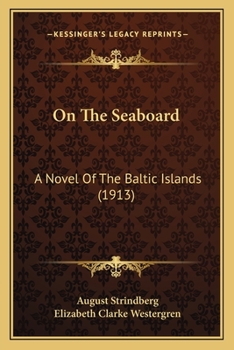
On The Seaboard: A Novel Of The Baltic Islands (1913)

Select Format
Select Condition 
Book Overview
""On The Seaboard: A Novel Of The Baltic Islands"" is a literary work written by the renowned Swedish author August Strindberg and published in 1913. The novel is set in the Baltic Islands, located in the northern part of Europe, and follows the story of a young woman named Elisabeth, who is forced to leave her home and family to start a new life on the islands.The novel explores themes of love, betrayal, and the struggle for independence, as Elisabeth navigates her new environment and tries to find her place in a society that is vastly different from what she is used to. Along the way, she encounters a cast of characters, including a wealthy landowner, a sailor, and a local fisherman, all of whom play a significant role in shaping her fate.Strindberg's writing is known for its psychological depth and realism, and ""On The Seaboard"" is no exception. The novel delves into the inner workings of the characters' minds, revealing their motivations and desires, and painting a vivid picture of life in the Baltic Islands during the early 20th century.Overall, ""On The Seaboard"" is a compelling work of fiction that offers a unique glimpse into a little-known corner of Europe, while also exploring timeless themes that are still relevant today. It is a must-read for fans of literary fiction, as well as anyone interested in the history and culture of the Baltic region.This scarce antiquarian book is a facsimile reprint of the old original and may contain some imperfections such as library marks and notations. Because we believe this work is culturally important, we have made it available as part of our commitment for protecting, preserving, and promoting the world's literature in affordable, high quality, modern editions, that are true to their original work.
Format:Paperback
Language:English
ISBN:116554265X
ISBN13:9781165542659
Release Date:September 2010
Publisher:Kessinger Publishing, LLC
Length:310 Pages
Weight:0.92 lbs.
Dimensions:0.7" x 6.0" x 9.0"
Customer Reviews
1 rating
Underappreciated Masterpiece
Published by Thriftbooks.com User , 17 years ago
As someone with an interest in Nietzsche and European literature, the concept of a "Nietzschean novel" intrigued me. The title itself might be (though I do not know for sure) a reference to an aphorism of Nietzsche's from "The Gay Science," or it might simply reflect Strindberg's fondness for the water. For a year or so I had been meaning to find a copy of this and read it, and about a day ago I finally did. "By the Open Sea" is in places a very beautifully written, if sometimes sluggish, work. There is a scene in particular towards the end where Axel Borg, the protagonist of the novel, mocks the simplicity of poets who describe the noise of the sea as a "roar" and then proceeds to give a detailed account of the "symphony" of sounds that make up this "roar" in a unique way. In a sense Axel Borg is much like many modern scientists who say that understanding all the most minute facts of a thing doesn't take away its mystery but in fact makes it more beautiful for its intricacy and depth. The dialogue is also engaging. While not Shakespearean, and nowhere near as poetic as Strindberg's narrative prose (which some might think is overwritten, but which I rather like), it is everything you would expect from someone who gained most of his fame as a dramatist. Most of the book is narrative prose, but it picks up speed as it goes on. "By the Open Sea" focuses heavily on the single character of Axel Borg and his over-sensitive nerves. Supposedly Kafka had a particular fondness for this work, and it's easy to see why. The modern consciousness is full of wounded, conflicted, and highly sensitive figures in literature. Axel Borg is similar to Kafka in his susceptibility to outside stimuli being overwhelming. At numerous points in the book he withdraws into solitude as an antidote to the uncleanness of associating with inferior people. In the first thirty or so pages of the book we are treated to Borg's recollections of his youth and we are given a rough sketch of his character. It essentially reads like a very compressed version of Nietzsche's philosophical conceptions of the "higher type" of humanity, allowing for some differences. Borg is a genius, intellectually versatile, unbound by the desires of the mass of humanity, aristocratic in temperament, is in control of himself (he doesn't react on instinct, doesn't pander to petty or popular prejudices), and enjoys working to create and to learn. He is described as of almost deliberately strong character, and he is also a complete misogynist. Throughout the book we are repeatedly confronted with his frustrations and defeats by these lesser people. Ultimately Borg, not an eminently likable character to most people in the first place, is driven to despair and madness. For all the condensed characterization in the beginning of the novel about Axel Borg's superiority, which in many respects must be granted, we end up reading about a man whose series of problems and failures slowly gnaws away at him until he rea
Copyright © 2026 Thriftbooks.com
Terms of Use | Privacy Policy | Do Not Sell/Share My Personal Information | Cookie Policy | Cookie Preferences | Accessibility Statement
ThriftBooks ® and the ThriftBooks ® logo are registered trademarks of Thrift Books Global, LLC
ThriftBooks ® and the ThriftBooks ® logo are registered trademarks of Thrift Books Global, LLC
