


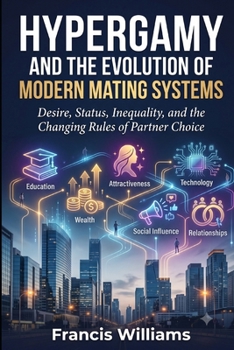
Hypergamy and the Evolution of Modern Mating Systems: Desire, Status, Inequality, and the Changing Rules of Partner Choice

Desire, Status, Inequality, and the Changing Rules of Partner Choice
Why do people choose the partners they choose?
For centuries, scholars, philosophers, religious leaders, and ordinary people have wrestled with this deceptively simple question. In recent years, the concept of hypergamy-the tendency to seek partners perceived as possessing higher status, resources, or desirability-has become a focal point of public debate. Advocates view it as a powerful explanation for modern dating dynamics, while critics argue that it oversimplifies the complexity of human relationships.
In Hypergamy and the Evolution of Modern Mating Systems, Williams moves beyond the polarization to examine a larger and more important question: How do modern mating systems actually work?
Drawing from evolutionary biology, anthropology, sociology, psychology, economics, demography, history, and technology studies, this book presents a comprehensive framework for understanding how human beings form relationships in a rapidly changing world. Rather than treating hypergamy as either a universal law or a myth, Williams places it within a broader system of interacting forces that shape attraction, partner selection, marriage, family formation, and social inequality.
The book begins by examining the origins of hypergamy and the evolutionary foundations of mate choice. Readers are introduced to concepts such as sexual selection, parental investment, status signaling, and reproductive strategy, exploring why certain preferences appear repeatedly across cultures and throughout history. These evolutionary insights provide an essential foundation while avoiding simplistic biological determinism.
The narrative then moves into history, demonstrating that for most of human civilization marriage functioned primarily as an economic, social, and political institution rather than a romantic one. Family alliances, inheritance systems, kinship structures, and social status often played a greater role in partner selection than individual attraction. Understanding this historical reality reveals how dramatically modern relationship systems differ from those of previous generations.
One of the book's central themes is the educational revolution that transformed modern mating markets. As educational attainment expanded-and as women increasingly surpassed men in higher education-the structure of partner selection changed in profound ways. Educational assortative mating, rather than traditional hypergamy, emerged as one of the most important forces shaping contemporary relationships.
The rise of digital dating receives extensive examination as well. Online platforms and matching algorithms have altered how people meet, evaluate, and select partners. While technology has expanded opportunities for connection, it has also created new forms of competition, visibility, and social comparison. The book explores how digital systems amplify existing human tendencies while introducing entirely new relationship dynamics.
Williams argues that one of the most important developments of the modern era is the emergence of multidimensional status. Traditional models often assumed that status could be measured through a relatively simple hierarchy. Contemporary societies, however, contain multiple forms of status, including education, income, occupational success, cultural capital, attractiveness, social influence, and personal qualities. This complexity makes many traditional explanations of mate choice increasingly inadequate.
At its core, Hypergamy and the Evolution of Modern Mating Systems argues that no single theory can adequately explain modern relationships. Hypergamy is real, but it is only one component of a far larger system. Human mate choice emerges from the interaction of biology, culture, economics, technology, institutions, and history.
Customer Reviews
ThriftBooks ® and the ThriftBooks ® logo are registered trademarks of Thrift Books Global, LLC
