


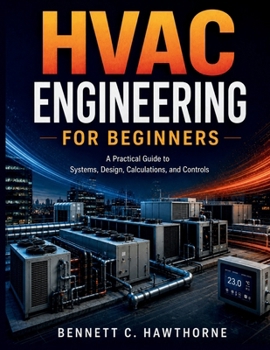
HVAC Engineering for Beginners: A Practical Guide to Systems, Design, Calculations, and Controls

Want to understand HVAC engineering from the fundamentals up?
Are you a student, aspiring HVAC technician, building-services professional, or simply looking to understand building systems better? HVAC ENGINEERING FOR BEGINNERS provides a clear introduction to heating, ventilation, and air conditioning.
Starting with fundamental principles, the book progressively connects heat, temperature, pressure, energy, heat transfer, and air properties to real HVAC equipment, systems, calculations, and design decisions.
Build Your HVAC Knowledge Step by StepExplore the foundations of HVAC, then move into the refrigeration cycle, its four major components, refrigerants, superheat, subcooling, and system performance.
You will also examine common systems, including split systems, heat pumps, packaged and rooftop systems, variable refrigerant flow, air handling systems, chilled-water systems, and central HVAC plants.
From there, learn how ventilation and indoor air quality relate to airflow, ductwork, fans, filters, dampers, and air devices, along with the fundamentals of duct, pipe, fan, and pump design.
Learn the Calculations, Not Just the FormulasBuild practical calculation skills through step-by-step worked examples that show the given information, applicable formula, substitution, solution, units, and engineering interpretation. Topics include airflow, heat transfer, heating and cooling capacity, efficiency, air systems, hydronic systems, and fan and pump performance. Part VII brings the essential relationships together with additional worked practice for learning and reference.
Understand Controls and Read HVAC DrawingsGo beyond identifying components and learn how HVAC systems respond to changing conditions through sensors, controllers, actuators, control valves, PID control, VAV systems, static pressure reset, and building automation.
You will also learn to read HVAC drawings by connecting equipment, ductwork, piping, airflow paths, and controls into a clear picture of how a system operates.
Put Everything TogetherThe book concludes with a complete small-building HVAC example, bringing the major concepts together through building requirements, load estimation, equipment selection, airflow, distribution, controls, drawings, and system evaluation.
The progression is simple:
Understand the physics.
Understand the equipment.
Understand the system.
Perform the calculations.
Understand the controls.
Read the drawings.
Think through the design.
Designed for mechanical engineering students, engineering graduates, HVAC apprentices and technicians, construction and facility management trainees, and building-services professionals, this book builds your knowledge progressively without assuming that you are already an HVAC expert.
If you are ready to connect the components, formulas, drawings, and principles into one clear engineering picture, this is where you should begin.
Start your journey with HVAC ENGINEERING FOR BEGINNERS today and build the foundation you need to understand HVAC systems with greater clarity, confidence, and engineering perspective.
Related Subjects
Engineering Science Science & Math Science & Scientists Science & Technology TechnologyCustomer Reviews
ThriftBooks ® and the ThriftBooks ® logo are registered trademarks of Thrift Books Global, LLC
