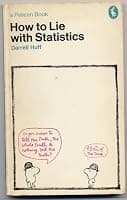
From distorted graphs and biased samples to misleading averages, there are countless statistical dodges that lend cover to anyone with an ax to grind or a product to sell. With abundant examples and illustrations, Darrell Huff's lively and engaging primer clarifies the basic principles of statistics and explains how they're used to present information in honest and not-so-honest ways. Now even more indispensable in our data-driven world than it was when first published, How to Lie with Statistics is the book that generations of readers have relied on to keep from being fooled.
This book has a cute title, and to an extent is true. However, it is more about what we perceive and interpret ourselves from what we read than an actual how-to statistics book. I read the original and the 29th printing. There is a reissued edition out there. However, I am not sure of a revised edition. After you read this to get a better perspective of the veracity of statistics and their usefulness (or not), you will want to read Outliers: The Story of Success by Malcolm Gladwell on the Pepsi Taste Test.
0
★★★☆☆
Great book, wrong version
By MelMc, May 21, 2025
Verified Purchase
Ordered for students who are reading it with the class, so it needs the same page numbers. The ones I was sent are a different edition than the ones pictured here.
0
★★★★★
very popular account of how statistics can be misused
By Thriftbooks.com User, February 13, 2008
Statisticians hate the old adage "Lies, Damned Lies and Statistics", but statistical methods do have that reputation with the general public. There are many excellent accounts, some even understandable to laymen that explain the proper ways to analyze, study and report the analysis of statistical data. Huff's famous account is illustrative and well written. It gives the average guy a look at how statistics is commonly misused (either unintentionally or deliberately) in the popular media. Graphical abuses are particularly instructive. Readers should recognize that statistical methods are scientific and with proper education anyone should be able to recognize the good statisticians from the charletons. For now Huff's book is still a good starting place. As a statistician I hate the public image portrayed in the quote above. However, I do sometimes have fun with it myself. As I write this review I am in my office wearing a sweatshirt that reads "When all else fails manipulate the data." A modern book by a consulting statistician on the same topic is "Common Errors in Statistics and How to Avoid Them" by Phil Good. If you enjoy this book take a look at Good's book also.
3
★★★★★
Great intro
By Thriftbooks.com User, January 12, 2005
-- with no equations. This book really is for every one. In fact, if you're a no-equations reader, this book will be especially helpful. It shows all the little tricks that advertisers and propagandists, government agencies included, throw at you every day. One, p.85, is an impressive sounding news article about teachers' pay. At first, it looks as if a generous government outlay had doubled or tripled teachers' salaries. Looking closer, however, one sees an odd cluster of unrelated numbers flying in close formation. None of the numbers quoted has any bearing on any other, at least none that the article's reader can discover. Duff also points out the fallacy of correlation. Oh, it's a useful enough measure, if (!) a number of mathematical requirements are met. It is not causation, however. For example, there is a strong correlation between a school child's height and the child's score on a given spelling test - taller kids do better. The fact is a lot less surprising when you see that first graders tend to be smaller than sixth graders, and tend to know fewer words. Maybe the example sounds silly, but no sillier than lots of the numbers in the news every day. This is a quick and approachable read, and true even if the examples are now dated. Despite its name, this book really is aimed at honest people, readers who want real understanding of the data thrown at them, and presenters who want their numbers to be understood properly. And best, you don't have to be a mathematician to see what's going on. //wiredweird
4
★★★★★
An Entertaining Primer on the Validity of Statistics
By Thriftbooks.com User, January 9, 2004
Although "How to Lie with Statistics" is a bit dated (having been written in the 1950's), the principles it puts forth are still valid today--if not moreso than ever--and the material is delivered in clear, concise, and even entertaining anecdotes and illustrations.How often do you hear statistics bandied about in the media or used to try to prove some special-interest point? "Of course" the people quoting the figures must be right with numbers on their sides... until you look at just how those numbers were arrived at.This book isn't truly a guide on how to lie with statistics, but it is an excellent text that informs the reader both how others will lie to them using statistics and on how to interpret the validity of purported statistical data.
4
★★★★★
Figures don't lie, but liars often figure ...
By Thriftbooks.com User, February 24, 2000
My introduction to this book was by way of the 'required reading' list for my undergraduate statistics course. Bad first impression. But the book turned out to be fun to read, and enormously instructive. The class material for my college statistics course taught me HOW to do statistics, but this book gave me a good beginning understanding into the common methods of the abuse of statistics. Conversely, by implication, it also teaches how to present information in as truthful a manner as possible. The knowledge served me well as I further studied statistics at a graduate level, and continues to serve me as a Government Technical person, constantly working with statistical tools. The book gives a good jump start into the interpretation of data presentations. Now, when I see a "Gee-Whiz Graph" I immediately know that the fluctuations shown in the line or bars are magnified, and I begin at once to look for the real difference (base 0) in the data points. This book is living proof that learning can be fun. I highly recommend it to anyone working with or beseiged by data presented as graphs, averages, trends or any other such means. It will open your eyes.