


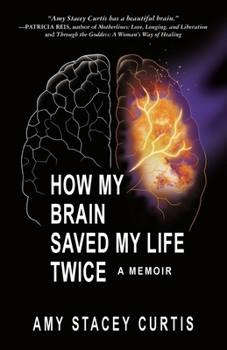
How My Brain Saved My Life Twice: A Memoir

She survived a devastating brain injury because she had already survived something harder.
Amy Stacey Curtis was a practicing installation artist widely recognized and awarded for an 18-year project presented throughout nine abandoned Maine mills. Soon after completing this ambitious opus, her brain was attacked. For 22 months, Amy would see horrific nonstop images of her suicide, this unrelenting psychosis soon accompanied by a debilitating head-to-toe loss of muscle control. Amy's arms and legs flailed, her hands and wrists curled, her head and neck swayed, and her cheeks and mouth twisted, requiring the use of a wheelchair, severely impacting her speech, and cutting her off from her community. After two psychiatric wards, eight antipsychotic drugs, and 15 months of misdiagnosing doctors, it was finally determined that Amy's brain was injured by past Lyme disease she never knew she had.
Amy's brain knew just what to do to protect her, to survive the unthinkable, and to heal what was broken-twice. Alternating between past and present-one saga that begins when Amy is seven as her father threatens to kill her, her three younger brothers, and himself, the other when Amy is 46 as a virus becomes determined to kill her by her own hand-this dual-timeline against-all-odds memoir chronicles Amy's battles and triumphs over suicide, relentless childhood trauma, and life-altering disability, with self-advocacy, perseverance, will, and a little humor.
How My Brain Saved My Life Twice could change the conversation around mental health and the hidden dangers of Lyme disease. As much as Amy's brain is a main character in her memoir, suicide is likewise a prominent theme: suicidal ideation caused by childhood trauma and suicidal psychosis caused by untreated Lyme disease.
Suicide is a taboo subject, though we should be talking about it. Globally, more than 720,000 people die by suicide every year. According to the Centers for Disease Control and Prevention, suicide is one of the leading causes of death in the United States, with one person dying by suicide every 11 minutes. Social media platforms censor or even remove posts that simply contain the word. To navigate this, many people share their stories using sentences like "I think about unaliving myself" and "My brother died by sewer slide."
Not saying suicide only adds to its stigma.
The author shares her battles and triumphs over suicide-witnessing her father's suicide, struggling with childhood-through-adulthood suicidal ideation, and enduring the horror of a long-term suicidal psychosis-in hopes of altering the perception of suicide as something under our control, something that is our fault, and in hopes of helping others in the midst of their own fight.
The author shares her fights and wins regarding her Lyme disease brain injury, as the general population and medical community don't yet seem to understand the damage Lyme disease can do, whether one has had it before, one has it now, or it was treated, not treated, or not treated enough.
The CDC estimates that around 476,000 people are diagnosed and treated for Lyme disease in the United States each year, while according to the U.S. Environmental Protection Agency, the reported cases are increasing due to climate change. Meanwhile, a study published in BMJ Global Health reports that the disease affects 14% of the world population.
The author hopes her story encourages the general population and the medical community to take Lyme disease more seriously, as well as helps accelerate the development of a human vaccine.
Customer Reviews
ThriftBooks® and the ThriftBooks® logo are registered trademarks of Thrift Books Global, LLC
