


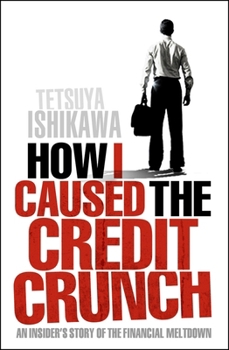
How I Caused the Credit Crunch


Select Format
Select Condition 
Book Overview
This is a vivid and personal account of 21st century banking excess. "How I Caused the Credit Crunch" traces seven years at the forefront of the credit markets - a tale from the heart of the bewildering banking maelstrom whose catastrophic collapse has plunged the world towards the worst recession since the 1930s. Tetsuya Ishikawa's story reveals how a young Oxford graduate finds himself in command of vast sums of other people's money; how a novice to the mysteries of hedge funds, subprime mortgages and CDOs can fix complex deals for billions of dollars in the exclusive bars, brothels and trading floors of London, New York, Frankfurt and Tokyo, and reap the benefits in a colossal annual bonus and an international luxury lifestyle. Ishikawa's book, which deftly explains the arcane financial instruments now grimly associated with the credit crunch, is both a powerful tale of lost innocence and an expose of the disturbing truth of the collective folly, frailty and greed at the heart of the banking crisis.
Format:Paperback
Language:English
ISBN:1848310676
ISBN13:9781848310674
Release Date:April 2009
Publisher:Icon Books
Length:368 Pages
Weight:0.65 lbs.
Dimensions:1.1" x 5.0" x 7.7"
Customer Reviews
2 ratings
If CDO, CDS, MBS, ABS, CMO etc and the cause of the financial crisis confuse you, read this.
Published by Thriftbooks.com User , 16 years ago
I got this book as I wanted to understand CDOs, CDSs, MBS etc without reading a heavy finance book that will put me to sleep. Heard that this book explains things quite well and I was not dissapointed. Being an ex-investment banker (plain vanilla equities) I knew a little about derivatives as I left the industry as they were taking off. This book gets into how things are originated, sold off to various counterparties and eventually you can clearly see how disaster was inevitable. The way the book was written makes it easy reading. The author writes from the prespective of Andrew Dover, a young Oxford grad who, with lucky career choices and hard work, wound up extremely successful in securitization. We learn about these products as Andrew learns the ropes in the business. All explanations done in layman terms with some back of the napkin diagrams to help. For once I can keep track! Of course, the story is full of the cliched lifestyle (fast cars, strippers, luxury vacations etc) you hear about, but definitely that is not far from the truth. These days there is a lot of anger directed at the bankers, who are the easiest targets to lay the blame. This book will give you a much better idea of the machinery that was behind the current financial crisis, and learn to avoid the pitfalls of liquidity and easy money. (if you can resist the temptation)
Sexed up, but still worth reading
Published by Thriftbooks.com User , 16 years ago
Tetsuya Ishikawa provides excellent insights into the dynamics behind the recent - almost as in `of recent memory' - global financial crisis. In the introductory chapter, Ishikawa admits quite openly that he had visions of writing something more serious but was told that he needed to include frequent and salacious accounts of binge drinking and libidinous partying at places like The Spearmint Rhino. Unless the author has a hefty name like George Soros, apparently no one would be willing to plough into an analysis of the causes of and lessons learnt from the most recent worldwide financial meltdown. Setting this aspect aside for the moment, Ishikawa does an admirable job of introducing and explaining the complex world of securitisation - asset-back securities, collateralised debt obligations, even "synthetic arbitrage CDOs" and other curious creatures. The author uses two devices to great advantage: the first person "this is actually how it happened - I was really there" narrative; and explanations of fairly sophisticated comments in the tight, no-nonsense shop talk of investment bankers. (His preferred didactic tool is the character Mike.) Two additional devices help the reader as well: frequent insertions of back-of-the-napkin schematics and the glossary appended to the text. If by chance you happen to have a son, nephew or grandson who can't seem to focus on fixed income instruments without frequent references to the pulchritude and short skirts of hedonistic secretaries and girlfriends, then this book would make an ideal gift - a sneaky way to educate him!
Copyright © 2026 Thriftbooks.com
Terms of Use | Privacy Policy | Do Not Sell/Share My Personal Information | Cookie Notice | Cookie Preferences | Accessibility Statement
ThriftBooks ® and the ThriftBooks ® logo are registered trademarks of Thrift Books Global, LLC
ThriftBooks ® and the ThriftBooks ® logo are registered trademarks of Thrift Books Global, LLC
