


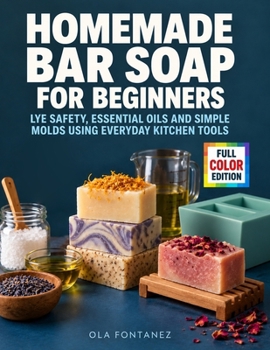
Homemade Bar Soap for Beginners: Lye Safety, Essential Oils and Simple Molds Using Everyday Kitchen Tools
No Customer Reviews

Most beginner soap guides explain the craft and skip the one step that actually worries a first-time reader most: handling lye. A bottle of sodium hydroxide sits sealed on the counter because the recipe in front of it jumps straight to oils and scent, never explaining what to actually do with the lye once it is finally open. That gap is not a small oversight. It is exactly why a curious first attempt at cold process soap so often stalls before a single batch is ever poured, the lye still sealed while the rest of the ingredients wait unused. A recipe alone was never the missing piece; a real, repeatable routine for that one caustic step was. What Changes Once Lye Stops Worrying YouSodium hydroxide gets measured on a digital scale, in grams, added into water in the one order that is always safe, every single session.A covered, ventilated workspace becomes routine, every tool laid out in advance, before the lye container is ever opened at all.Trace gets read by sight and feel instead of guessed at, from a thin, watery pour to a ribbon that briefly holds before sinking back in.A splash on skin or in the eyes has an already-rehearsed response, worked out calmly long before it could ever actually happen.A batch that seizes too fast, or clouds over with harmless soda ash, gets a specific fix instead of a worried shrug.Four full recipes follow in a fixed order of rising skill, each one adding exactly one new technique to what the last one already taught.
Why the Lye Chapter Comes First This book puts every chapter on lye handling ahead of a single recipe, never folded into one as a rushed afterthought, because a beginner deserves to feel genuinely steady with the one dangerous part before ever being handed anything else to manage, and every measurement afterward is set by weight, in grams, on the same kind of digital scale a working soapmaker actually uses, so nothing is ever left to a cup, a spoon, or a guess. The four recipes that follow are sequenced deliberately rather than dropped in at random: a plain castile bar teaches the entire eight-stage process once, without any distraction pulling focus away; a layered and swirled bar comes next, poured once trace already feels familiar; an oatmeal and honey bar introduces its own gentle, genuinely heat-generating reaction; and an activated charcoal bar closes the sequence, built for real exfoliating scrub rather than a striking colour alone. Once that first careful mix stops feeling nerve-wracking, the actual craft, colour, scent, and texture, turns out to be the easier half of the whole process, and it is the half most guides spend all their time on instead. Four to six weeks after that first careful mix, a bar cured on a rack in an ordinary kitchen looks nothing like the sealed bottle that started it, and troubleshooting along the way gets the same plain treatment as the lye chapter that opens the book. What is left, once the one genuinely dangerous step is put in its place, is the enjoyable part of the craft: colour, scent, and texture, decided on purpose rather than guessed at. Start with the lye chapter. Everything else follows calmly from there.
Why the Lye Chapter Comes First This book puts every chapter on lye handling ahead of a single recipe, never folded into one as a rushed afterthought, because a beginner deserves to feel genuinely steady with the one dangerous part before ever being handed anything else to manage, and every measurement afterward is set by weight, in grams, on the same kind of digital scale a working soapmaker actually uses, so nothing is ever left to a cup, a spoon, or a guess. The four recipes that follow are sequenced deliberately rather than dropped in at random: a plain castile bar teaches the entire eight-stage process once, without any distraction pulling focus away; a layered and swirled bar comes next, poured once trace already feels familiar; an oatmeal and honey bar introduces its own gentle, genuinely heat-generating reaction; and an activated charcoal bar closes the sequence, built for real exfoliating scrub rather than a striking colour alone. Once that first careful mix stops feeling nerve-wracking, the actual craft, colour, scent, and texture, turns out to be the easier half of the whole process, and it is the half most guides spend all their time on instead. Four to six weeks after that first careful mix, a bar cured on a rack in an ordinary kitchen looks nothing like the sealed bottle that started it, and troubleshooting along the way gets the same plain treatment as the lye chapter that opens the book. What is left, once the one genuinely dangerous step is put in its place, is the enjoyable part of the craft: colour, scent, and texture, decided on purpose rather than guessed at. Start with the lye chapter. Everything else follows calmly from there.
Format:Paperback
Language:English
ISBN:B0HMS5W6NB
ISBN13:9798161907368
Release Date:October 2026
Publisher:Independently Published
Length:130 Pages
Weight:0.70 lbs.
Dimensions:0.3" x 8.5" x 11.0"
Customer Reviews
0 rating
Copyright © 2026 Thriftbooks.com
Terms of Use | Privacy Policy | Do Not Sell/Share My Personal Information | Cookie Notice | Cookie Preferences | Accessibility Statement
ThriftBooks ® and the ThriftBooks ® logo are registered trademarks of Thrift Books Global, LLC
ThriftBooks ® and the ThriftBooks ® logo are registered trademarks of Thrift Books Global, LLC
