


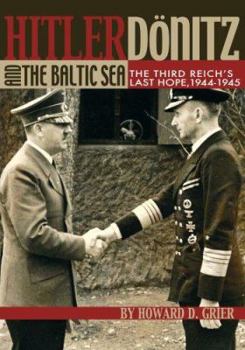
Hitler, Donitz, and the Baltic Sea: The Third Reich's Last Hope, 1944-1945


The popular conception of Hitler in the final years of World War II is that of a deranged Fuhrer stubbornly demanding the defense of every foot of ground on all fronts and ordering hopeless attacks... This description may be from another edition of this product.
Format:Hardcover
Language:English
ISBN:1591143454
ISBN13:9781591143451
Release Date:May 2007
Publisher:Naval Institute Press
Length:320 Pages
Weight:1.22 lbs.
Dimensions:1.0" x 6.0" x 9.0"
Customer Reviews
5 ratings
Why did Hitler hold out in the EAst so long?
Published by Thriftbooks.com User , 16 years ago
This book presents an interesting point of view on why Hitler held on so long and so hard in Russia when his generals all wanted to pull back and beef up the front lines with the troops that would be released. Hitler of course wanted to keep the Finns in the war, and being as far east as possible gave them incentive to hang in, but even more than that, is the fact that the Kriegsmarine wanted and needed the Baltic as a safe zone for U-boot crew training and boat shake down cruises. Given that spin, it becomes clear why Hitler insisted that the East hold. Time was needed for the Kriegsmarine to build, train and deploy the next generation of U-boot to turn the tide, strangle England, and win the war. A good book from the Naval Institute Press, worth the read.
Priceless for Understanding Donitz becoming Hitler's Heir
Published by Thriftbooks.com User , 17 years ago
It has always seemed peculiar that in his last testament, Hitler named Donitz as his successor. An Admiral? Why not a General, a commander of armies? If you read this book, you will have a good idea of the reasoning behind the decision. David Grier has done a fine job in going behind the scenes of the war in the Baltic States and Prussia to explain the relationship that developed between these two men and how Hitler came to recognize Donitz' for his intelligence, loyalty and fanatical acceptance of the National Socialist ideals. As the Grand Admiral of the German Navy for the last three years of the war, Donitz was instrumental in getting Hitler to protect the Baltic Sea so that the Navy had somewhere to train it's submariners. By holding onto the Baltic shoreline he was able to bring supplies to many of the troops holding onto ports where civilians and soldiers could later be evacuated. He also had 'fortress cities' designated to protect his Navy that the Army could have easily done without. At all times he was both a Nazi and a Navy man who's loyalty never wavered (for good or ill). Grier's study of this little known battle area is in itself a great addition to the works that follow the 'Eastern Front'. Little of consequence has been written as to the strategic placement of the Baltic States and what their occupation meant to the German war effort, especially as it contributed to military strategy at the end of the war. Grier does a good job of including maps that describe overall strategy and the movement of armies and attacks. I have only two small negative comments: 1) on some of the maps, cities that are the anchors of troops or battles are missing; 2) the first map at the beginning purports to be the Baltic in 1944, but, still has Poland and Czechoslovakia with their pre-1938 boundaries and Memel as still part of Lithuania (so that it's more like 1937). Yes I know that the second is picky, but for such a fine book, this is a glaring mistake. Zeb Kantrowitz
Worth Reading at Twice the Price
Published by Thriftbooks.com User , 19 years ago
This book offers an excellent view of hitlers final months, and his over-arching strategy. I highly recommend this book!
Well written with some compelling arguments
Published by Thriftbooks.com User , 19 years ago
A well written and researched book with some compelling arguments that offers a convincing explanation that Hitler had indeed a strategy in the last two years of the war, other than a mad obsession with holding every inch of ground, no matter what the cost. The basis of the book is that Hitler based his strategy on one simple premise, that to avoid total defeat he needed to neutralize the western allies for just enough time to defeat the Soviet Union, which would allow him to broker a peace deal with the western allies. To do this, he needed to keep the Baltic Sea firmly under German control; to allow for new revolutionary U-boats to be commissioned, (despite heavy allied bombing the new U Boats were starting to be produced faster than ever in early 1945) and their crews trained away from constant allied air and naval attacks, this would allow Germany to stop the flood of US supplies to the Soviet Union as well as making further British and American offensive operations in the west more difficult due to the disrupted supply lines. The book shows how Hitler quite rightly understood that alternative strategies offered by his Generals merely proposed to delay Germanys defeat, while only Donitz and his new U-boats offered the only if slim possibility of victory. The book is a delight to read, and deserves a wider audience.
Thoughtful Analysis of the Last Gasp Strategy of the Third Reich
Published by Thriftbooks.com User , 19 years ago
Hitler's selection of Commander in Chief of the German Navy, Karl Doenitz as his succesor in the closing days of World War II is often viewed as puzzling and illogical. Howard Grier's "Hitler, Doenitz and the Baltic Sea" attempts to explain why the selection of a Navy man rather than a high-ranking Nazi party hack or a German Army Field Marshal to succeed Hitler made sense, at least to Hitler. The reason for the selection stems from the Nazi's long-range plans for Germany to dominate, if not conquer outright, the entire world. Such plans would naturally have to include a full scale naval fleet. Nazi Germany, however, was never able to develop such a fleet, particularly after the invasion of Poland when the declarations of war by Britain and France against Germany, and Germany's subsequent invasion of the Soviet Union, necessitated Germany's primary economic and military focus on land-based warfare. Japan, however, in 1941 did have a full scale navy (arguably even the biggest and best in the world). It was for this reason, the use of Japan's naval forces against the navies of the Western powers, that Germany appeared to welcome Japan's attack on the U.S. and why Germany declared war on the U.S. immediately thereafter. The author's book examines how the Nazis never lost sight of their hope for world domination through their own naval force and how even in the last year, months, and weeks of the war they planned to at least force a peace with the West (and then re-conquer lands lost in the East) by utilizing a new type of submarine, the XXI U-boat, to damage and destroy British and American shipping, with the end result being that the British would starve and the Americans would not be able to re-supply Britain or ferry troops and materiel to continue the war in Europe. The book is a thoughtful analysis of the overall strategy of the Nazi Empire in the closing months of the war and helps explain why Hitler believed up to the end that the Nazis could reverse their fortunes. It also helps explain why the Nazis were desperate to hold onto ports in the Baltic Sea and retain possession of Norway: After the invasion of Normandy, these were the only areas left under German control that could be used to test the new submarines, train their crews, and launch a U-boat counteroffensive. Although the book may appear to be of interest only to naval historians, particularly as it relates to World War II, its scope is more wide-ranging than that and would be useful for those interested in World War II in general as well.
Copyright © 2026 Thriftbooks.com
Terms of Use | Privacy Policy | Do Not Sell/Share My Personal Information | Cookie Policy | Cookie Preferences | Accessibility Statement
ThriftBooks ® and the ThriftBooks ® logo are registered trademarks of Thrift Books Global, LLC
ThriftBooks ® and the ThriftBooks ® logo are registered trademarks of Thrift Books Global, LLC
