


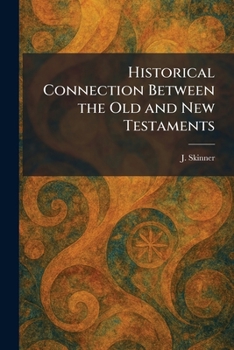
Historical Connection Between the Old and New Testaments

"Historical Connection Between the Old and New Testaments" provides a scholarly and detailed exploration of the crucial centuries bridging the Hebrew Scriptures and the emergence of the New Testament. Written by the distinguished theologian and scholar Principal J. Skinner, this work illuminates the influential years of biblical history, tracing the evolution of Jewish thought, political structures, and religious practices under successive imperial powers.
The text examines the significant impact of the Persian, Hellenistic, and Roman periods on the Jewish people, offering a clear narrative of the events that paved the way for the world of the Gospels. Key topics include the Maccabean revolt, the development of diverse Jewish sects, and the shifting theological horizons that characterized the Second Temple period. By contextualizing the transition from the Old to the New Testament, Skinner offers readers a profound understanding of the historical and cultural continuity within the biblical tradition. This volume remains an essential resource for students of theology, history, and biblical studies seeking to grasp the complex heritage of the Judeo-Christian faith.
This work has been selected by scholars as being culturally important, and is part of the knowledge base of civilization as we know it. This work was reproduced from the original artifact, and remains as true to the original work as possible. Therefore, you may see the original copyright references, library stamps (as most of these works have been housed in our most important libraries around the world), and other notations in the work.
This work is in the public domain in the United States of America, and possibly other nations. Within the United States, you may freely copy and distribute this work, as no entity (individual or corporate) has a copyright on the body of the work.
As a reproduction of a historical artifact, this work may contain missing or blurred pages, poor pictures, errant marks, etc. Scholars believe, and we concur, that this work is important enough to be preserved, reproduced, and made generally available to the public. We appreciate your support of the preservation process, and thank you for being an important part of keeping this knowledge alive and relevant.
Customer Reviews
ThriftBooks ® and the ThriftBooks ® logo are registered trademarks of Thrift Books Global, LLC
