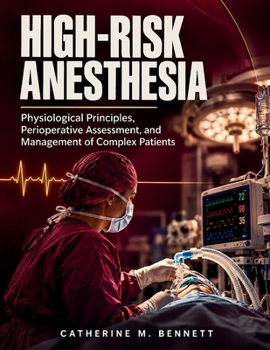
High-Risk Anesthesia: Physiological Principles, Perioperative Assessment, and Management of Complex Patients

A patient with an ejection fraction of 25%, pulmonary hypertension, chronic kidney disease, and an urgent hip fracture is scheduled for surgery tomorrow. Induction could trigger cardiovascular collapse. Positive-pressure ventilation could compromise an already failing right ventricle. Delaying surgery carries risks of its own.
How do you build an anaesthetic plan when every decision can narrow an already limited margin of safety?
Anesthesiology residents, fellows, and practicing anesthesiologists face that question with resources that pull in different directions. General textbooks cover each disease in isolation. Guideline summaries state thresholds without the physiology that explains when they fail. Crisis cards give fixed sequences written for a different patient. The reasoning that connects assessment, planning, and rescue in one compromised patient is rarely written down in one place.
High-Risk Anesthesia is that place. It is a comprehensive textbook of clinical reasoning for the patient whose physiological reserve has already been spent. It teaches how to recognize why a particular patient is at risk, how that risk should reshape the anesthetic plan, and how to anticipate and manage complications from preoperative assessment through recovery and handover, and how to adapt each recommendation when the patient does not match the one the guideline described.
What this book helps you do
Stratify preoperative risk with validated scores and functional assessment, optimize what can be optimized, and decide on the timing of surgery and the handling of chronic medications.Plan anesthesia for coronary disease, heart failure, valvular disease, pulmonary hypertension, arrhythmias, and implanted cardiac devices, with applied physiology and vasoactive pharmacology.Build airway strategies rather than single plans, conduct a high-risk induction, and act decisively in cannot-intubate, cannot-oxygenate situations.Manage kidney, liver, endocrine, neurological, and acid-base disease; antithrombotic therapy around neuraxial blocks; coagulopathy, massive transfusion, and patient blood management.Lead the response to shock, sepsis, major hemorrhage, anaphylaxis, malignant hyperthermia, local anesthetic systemic toxicity, and perioperative cardiac arrest.Interpret hemodynamic monitoring and point-of-care ultrasound, and adapt every principle to frail older adults, high-risk obstetric patients, and high-risk children.Inside the book
Nine parts and thirty-nine self-contained chapters run from the foundations of perioperative risk through organ systems and crises to monitoring, special populations, postoperative care, and team performance. Every chapter opens with learning objectives and closes with key points and references. Clinical Pearl, Safety Alert, Common Error, Escalation Criteria, and Evidence Update boxes mark what deserves attention. Forty-three composite clinical scenarios and worked examples show the reasoning applied to a decision. Structured medication entries, forty figures, more than two hundred tables, and appendices on emergency drug doses, risk scores, and crisis checklists support rapid lookup. Content is grounded in current international guidelines, prescribing information, and peer-reviewed evidence, with United States practice as the default and meaningful United Kingdom and European differences stated. Evidence is current to October 2026.
Written for anesthesiology residents and fellows and for practicing anesthesiologists, the book will also serve clinicians in critical care, perioperative medicine, and emergency medicine. It is an educational and reference resource intended to support, not replace, clinical judgment.
Add this textbook to your clinical library and bring explicit, physiology-based reasoning to the patients for whom the margin of safety is narrowest.
Customer Reviews
ThriftBooks ® and the ThriftBooks ® logo are registered trademarks of Thrift Books Global, LLC