


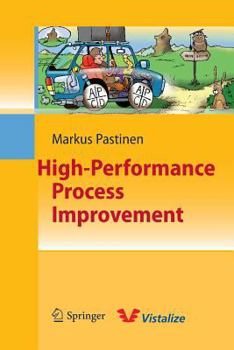
High-Performance Process Improvement
No Customer Reviews

Select Format
Select Condition 
Book Overview
1 High-Performance Process Improvement Fundamentals 1.1 Why is Process Improvement an Enormous Waste of Resources and Opportunities? 1.2 Why are the Process Improvement Methods Outdated? 1.3 The Critical Questions the Business Books Missed to Ask and Answer - Until Now 1.4 The Current and Prospective State of Process Improvement Methods 1.5 The Research and Development Work and Its Result 1.6 The Size of the Improvement Momentum Toyota Loses Every Day and the Momentum Your Company Could Gain Every Day 1.7 Designing High-Performance Process Improvement Methods 1.8 Defining the Performance Requirements of High-Performance Process Improvement Efforts 1.9 Summary and Concluding Remarks 2 High-Performance Process Improvement Concepts 2.1 Key Definitions 2.2 Delivery of Value 2.2.1 Delivery of Value from a Holistic Perspective 2.2.2 Delivery of Value from a Stakeholder Perspective 2.2.2.1 Customer Satisfaction 2.2.2.2 Employee Satisfaction 2.2.2.3 Owner Satisfaction 2.3 The Kernel of High-Performance Process Improvement 2.4 The Process and Total Improvement Yield 2.4.1 The Process Improvement Yield Concept 2.4.2 The Total Improvement Yield Concept 2.5 Summary and Concluding Remarks 3 Design Concepts of the High-Performance Process Improvement Process 3.1 Standardization and Manageability 3.2 Optimizing the Interaction of the Process Components 3.2.1 People 3.2.2 Technology 3.2.3 Information 3.3 Applying the Concept of Reverse Engineering 3.4 The Total Picture 3.5 Assuring the Quality of the Experts in Charge of the High-Performance Process Improvement Process 3.6 Summary and Concluding Remarks 4 Network and Company Analysis and Synthesis 4.1 Introduction 4.2 The Process Flow 4.3 The Data Collection and Analysis Criteria 4.3.1 The Functional Perspective 4.3.2 The Operational Perspective 4.3.3 The Time Space Perspective 4.3.4 Data Collection Criteria Case 4.3.5 Data Collection Concerns 4.4 The Synthesis 4.5 The T and V Values 4.6 Summary and Concluding Remarks 5 Process Analysis and Synthesis 5.1 Introduction 5.2 Overview 5.2.1 The VISTALIZER(R) for Consultants Concept 5.2.2 The VISTALIZER(R) Process Analysis and Synthesis Framework 5.3 Phase 1: Initiation and Modeling 5.3.1 Initiation of the Analysis (Phase 1.1) 5.3.2 Modeling of the Focus Process (Phase 1.2) 5.3.3 Scope Definition and Data Collection Planning (Phase 1.3) 5.4 Phase 2: Data Collection and Basic Definitions 5.4.1 Determination of the Process Performance Parameters (Phase 2.1) 5.4.1.1 Time Analysis Parameters 5.4.1.2 Quality Analysis Parameters 5.4.1.3 Cost Analysis Parameters 5.4.1.4 Examples of Chosen Analysis Parameters 5.4.2 Creation of the Impact Field (Phase 2.2) 5.4.2.1 The Supplements of the Impact Field 5.4.2.2 Examples of Impact Fields 5.4.3 Giving Priority to the Analysis Parameters (Phase 2.3) 5.4.4 Calculation of Criterion 1 and the Reliability Index of the Impact Field (Phase 2.4) 5.4.5 Planning for the External Analysis (Phase 2.5) 5.4.6 Setting the Objectives and Evaluation of the Preliminary Monetary Gains (Phase 2.6) 5.5 Phase 3: Subprocess Specific Improvement Plans 5.5.1 Analysis of the Specific Subprocesses (Phase 3.1) 5.5.1.1 Defining the Subprocess Components (Phase 3.1.1) 5.5.1.2 Identifying Improvement Objects (Phase 3.1.2) 5.5.1.3 Placing the Improvement Objects in Order of Importance (Phase 3.1.3) 5.5.1.4 Rough Analysis of Likely Causes and Potential
Format:Paperback
Language:English
ISBN:3642425275
ISBN13:9783642425271
Release Date:October 2014
Publisher:Springer
Length:25 Pages
Weight:0.76 lbs.
Dimensions:0.5" x 6.1" x 9.2"
Customer Reviews
0 rating
Copyright © 2026 Thriftbooks.com
Terms of Use | Privacy Policy | Do Not Sell/Share My Personal Information | Cookie Notice | Cookie Preferences | Accessibility Statement
ThriftBooks ® and the ThriftBooks ® logo are registered trademarks of Thrift Books Global, LLC
ThriftBooks ® and the ThriftBooks ® logo are registered trademarks of Thrift Books Global, LLC
