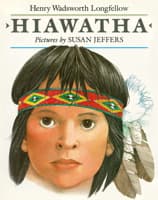
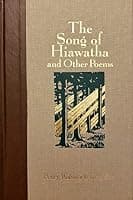
The classic Longfellow poem, made fresh and vivid for today's young readers with beautiful full-color illustrations from acclaimed artist Errol LeCain.
Well, I can't add significantly to what was written so eloquently by the previous reviewer. I do, however, want to add my voice in recognition of an absolutely lovely book. I appreciate that this is not an abridged, adulterated story of Longfellow's poem. The illustrations are as deeply hued and richly textured as the spellbinding poem itself, a flawless blending of media. My father read Hiawatha to me as a child, and I've read Hiawatha's Childhood to my son. I hope he will read this luminous version to his children one day, and think of Grandma and Nokomis and the interconnectedness of elements in this lovely world. ...And about how much fun it would be to have a squirrel as a friend!
0
★★★★★
A tuckshop of poetry? This is a banquet spread before us..!
By Thriftbooks.com User, December 11, 1997
Bettina Hurlimann, writing in 'Three Centuries Of Children's Books In Europe', poses a question: " Up and down the country today, it is still a fairly frequent occurrence to see children playing in feathered headdresses, waving their plastic tomahawks or their unsmokeable pipes of peace..... . Why does almost every 12 year old child today know almost as much about the Sioux Indians as be does about the original inbabitants of our own country?..." In 1850, the answer would have been, "From reading James Fenemore Cooper!" Cooper's novels, though not corresponding to historical truth, fed the voracious appetites of readers for whom the Romantic Movement in European and American Literature had already idealized the frontiersman and ennoblized bis Indian Brother. The Publication, in 1855, of Longfellow's 'Song Of Hiawatha', based on the traditions of Indians living on the shores of the Great Lakes, was timely. In this long poem, the first work of his retirement from University Life, Longfellow created an Indian counterpart to the European Hero-sagas that had first fascinated him during his earlier study tours of the Continent. Heavily influenced by German and Scandinavian poets, he modelled his poem on the Finnish collection, 'Kalevala', and would not have envisaged that his epic would become one of those pieces of adult literature that children take, from time to time, as their own. "..Children who are profoundly sympathetic to the affairs of Nature and quite averse to the affairs of economists, must necessarily give their hearts to the Indians and adopt them completely into their literature.." `Hiawatha's Childhood', the section of the saga deemed most appropriate for children, has appeared in countless anthologies and readers. John Drinkwater once described Longfellow's ability as an 'awakener of poetry in the young' in a selection of mixed metaphors Longfellow would never have countenanced: ".. He has been the genial and inspiring doorkeeper of the temple. His easy and satisfying rhythm, his rich yet simple suggestion of things venerable and picturesque and a certain unction in all he wrote, combine to make his works the very tuckshop of poetry for young readers..." Now, to that smorgasbord, is added another 'Hiawatha's Childhood', this version a Greenaway Medal winner, (1984). Published by Faber and Faber, it is presented in picture-story book form, illustrated by Errol Le Cain, a Hong Kong expatriot resident in Britain but gaining international accreditation. Not for Le Cain the lightweight illustrations prevalent in Reading Scheme Primers; not for Faber the 'translation' for kiddies, the talking down or compromise or structured vocabulary. Instead, Longfellow's original, unadulterated, alliterative verses are presented in sizeable slabs of 3mm. print, attractively yet firmly bordered off from the pictures so that young readers can concentrate on the one or the other. The artwork would appear to have borrowed from Middle Age manuscrip