


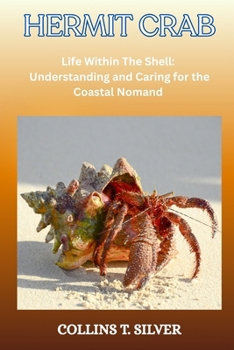
Hermit Crab: Life Within the Shell: Understanding and Caring for the Coastal Nomad
No Customer Reviews

Hermit crabs are fascinating invertebrates that belong to the infraorder Anomura within the order Decapoda, a large grouping that also includes lobsters, true crabs, and shrimp. Despite their name and external resemblance to true crabs, hermit crabs are not considered "true" crabs (which are classified under the infraorder Brachyura). The main distinguishing feature between them lies in their asymmetrical abdomens, which are soft, unsegmented, and lack the calcified exoskeleton found in most other decapods. This anatomical peculiarity necessitates the use of external shells, typically abandoned gastropod shells, to protect their vulnerable posterior region.
Hermit crabs are divided into two main ecological categories: marine and terrestrial. Most of the approximately 800 known species are marine, living their entire lives underwater. Only about 17 species are terrestrial, inhabiting coastal zones and requiring both access to water and moist air for survival.
Taxonomically, hermit crabs are spread across several families, most notably:
Paguridae - the largest family, encompassing many marine species.
Coenobitidae - the family that includes all known terrestrial hermit crabs, such as Coenobita clypeatus and Coenobita compressus.
Diogenidae - the so-called "left-handed" hermit crabs, which use their left claw as the dominant one, unlike Paguridae.
Each species exhibits unique traits in coloration, size, shell preference, behavior, and environmental requirements, reflecting their adaptation to diverse habitats. Most hermit crabs have five pairs of legs, though the last two are tiny and mainly used to grip the interior of their shells. Their compound eyes, mounted on stalks, and antennae help with spatial awareness and environmental detection.
The need for a gastropod shell is a hallmark of their classification. However, what truly sets them apart taxonomically is the combination of soft abdominal morphology, their dependency on borrowed shelters, and their remarkable versatility in exploiting environmental niches. These traits not only define their biology but also play a foundational role in understanding their care in captivity.
Hermit crabs are divided into two main ecological categories: marine and terrestrial. Most of the approximately 800 known species are marine, living their entire lives underwater. Only about 17 species are terrestrial, inhabiting coastal zones and requiring both access to water and moist air for survival.
Taxonomically, hermit crabs are spread across several families, most notably:
Paguridae - the largest family, encompassing many marine species.
Coenobitidae - the family that includes all known terrestrial hermit crabs, such as Coenobita clypeatus and Coenobita compressus.
Diogenidae - the so-called "left-handed" hermit crabs, which use their left claw as the dominant one, unlike Paguridae.
Each species exhibits unique traits in coloration, size, shell preference, behavior, and environmental requirements, reflecting their adaptation to diverse habitats. Most hermit crabs have five pairs of legs, though the last two are tiny and mainly used to grip the interior of their shells. Their compound eyes, mounted on stalks, and antennae help with spatial awareness and environmental detection.
The need for a gastropod shell is a hallmark of their classification. However, what truly sets them apart taxonomically is the combination of soft abdominal morphology, their dependency on borrowed shelters, and their remarkable versatility in exploiting environmental niches. These traits not only define their biology but also play a foundational role in understanding their care in captivity.
Format:Paperback
Language:English
ISBN:B0FK3RGG8X
ISBN13:9798292916284
Release Date:July 2025
Publisher:Independently Published
Length:150 Pages
Weight:0.46 lbs.
Dimensions:0.3" x 6.0" x 9.0"
Customer Reviews
0 rating
Copyright © 2026 Thriftbooks.com
Terms of Use | Privacy Policy | Do Not Sell/Share My Personal Information | Cookie Policy | Cookie Preferences | Accessibility Statement
ThriftBooks ® and the ThriftBooks ® logo are registered trademarks of Thrift Books Global, LLC
ThriftBooks ® and the ThriftBooks ® logo are registered trademarks of Thrift Books Global, LLC
