


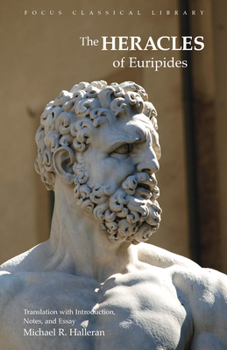
The Heracles of Euripides (Focus Classical Library)


Select Format
Select Condition 
Book Overview
In Herakles, Euripides reveals with great subtlety and complexity the often brutal underpinnings of our social arrangements. The play enacts a thoroughly contemporary dilemma about the relationship... This description may be from another edition of this product.
Format:Paperback
Language:English
ISBN:0941051013
ISBN13:9780941051019
Release Date:January 1988
Publisher:Focus
Length:96 Pages
Weight:0.26 lbs.
Dimensions:8.5" x 0.2" x 5.5"
Customer Reviews
1 rating
Euripides looks at the subject of political refugees
Published by Thriftbooks.com User , 22 years ago
"The Children of Herakles" has usually been considered a minor political play by Euripides. First performed in 430 B.C.E. it tells of how the children of Herakles were exiled by from their home by the murderous King Eurystheus of Argos (the one who imposed the famous Twelve Labors on the demi-god) after their father's death. The children and their mother fled from country to country in search of sanctuary until, of course, they came to Athens. At first, the Athenians are reluctant to grant asylum, since Eurystheus might bring political and military strife on the city. But Demophon, King of Athens, agrees to admit them. Indeed, the army of Eurystheus surrounds the city and the oracles declares that the safety of Athens depends on the sacrifice of a virgin. Macaria, one of the daughters of Herakles, offers herself as the sacrificial victim. There is then a surprising twist as Eurystheus is captured and Alkmene, the mother of Herakles, insists that the tyrant be put to death.This play has usually been considered to be nothing more than a glorification of Athens, but, of course, in more contemporary terms it is worth reconsidering this Greek tragedy as a look at the problem of political refugees. This comes approach focuses on the debate the Athenians have over accepting the refugees. In this context it is not simply that Athens is a great place because it accepts the children of Herakles but rather that doing so is a political action of some significance; historically we know that the Athenians were not as generous as Euripides depicts them, but then we also recognize that the tragic playwright was try to inspire his audience. There is also a clear sense of the refugees as being heroic rather than pathetic, not only because of Macaria's willingness to be sacrificed but simply because they have survived. You can consider every refugee to be a success story because they have survived and made it out of their troubled homeland alive. "The Children of Herakles" works well as an analog to "Medea," with the one play dealing with the topic of how Athens treated refugees and the other touching on how the city tolerated foreigners. However, as with other plays by Euripides, such as "Trojan War," this tragedy is also a meditation on the effects of war. This is one of the shortest plays in Greek drama, but it is arguably one of the most complex of the plays of Euripides. The play suffers from having a particular character dominate the action or a truly great heroic scene and this is never going to be one of the first Greek tragedies anybody is going to look at (indeed, it apparently was never performed in the United States until just recently). But even if it comes at the end of your study of Euripides, it is still a play worth considering for what it says about the playwright and his attempts to inspire his Athenian audience.
Copyright © 2026 Thriftbooks.com Terms of Use
| Privacy Policy | Do Not
Sell/Share My Personal Information | Cookie Policy | Cookie Preferences | Accessibility Statement
ThriftBooks® and the ThriftBooks® logo are registered trademarks of Thrift Books Global, LLC
ThriftBooks® and the ThriftBooks® logo are registered trademarks of Thrift Books Global, LLC
