


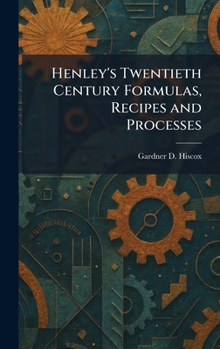
Henley's Twentieth Century Formulas, Recipes and Processes

"Henleys Twentieth Century Formulas, Recipes and Processes" is an exhaustive and indispensable reference work that compiles thousands of practical trade secrets, chemical recipes, and industrial processes. Edited by Gardner D. Hiscox, this monumental collection serves as a comprehensive guide for manufacturers, artisans, and homeowners alike, offering a window into the technological and domestic practices of the early twentieth century.
The work covers an astonishing breadth of subjects, including adhesives, beverages, cleaning preparations, cosmetics, metallurgy, photography, and wood preservation. From specialized industrial applications to simple household remedies, each formula is presented with clarity, reflecting the era's drive for scientific efficiency and self-sufficiency. This compendium is not merely a historical curiosity but a testament to the ingenuity of the industrial age, providing detailed instructions on everything from creating high-quality dyes and varnishes to the preparation of medicinal compounds and food products.
Whether used for historical research or as a fascinating exploration of traditional craftsmanship, "Henleys Twentieth Century Formulas, Recipes and Processes" remains a valuable resource for anyone interested in the chemistry and mechanics that powered a bygone era.
This work has been selected by scholars as being culturally important, and is part of the knowledge base of civilization as we know it. This work was reproduced from the original artifact, and remains as true to the original work as possible. Therefore, you may see the original copyright references, library stamps (as most of these works have been housed in our most important libraries around the world), and other notations in the work.
This work is in the public domain in the United States of America, and possibly other nations. Within the United States, you may freely copy and distribute this work, as no entity (individual or corporate) has a copyright on the body of the work.
As a reproduction of a historical artifact, this work may contain missing or blurred pages, poor pictures, errant marks, etc. Scholars believe, and we concur, that this work is important enough to be preserved, reproduced, and made generally available to the public. We appreciate your support of the preservation process, and thank you for being an important part of keeping this knowledge alive and relevant.
Customer Reviews
ThriftBooks ® and the ThriftBooks ® logo are registered trademarks of Thrift Books Global, LLC
