


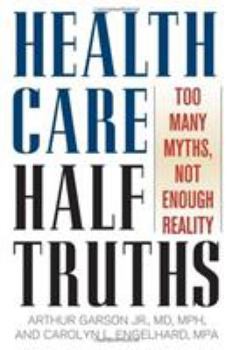
Health Care Half Truths: Too Many Myths, Not Enough Reality (American Political Challenges)

Select Format
Select Condition 
Book Overview
Are you tired of hearing that the American health care "system" is broken? Well, it is. You can't understand your bill-or pay it; you wait an hour before seeing the doctor for ten minutes; and that was your child who was just laid off, and whose family has no health insurance. Health Care Half-Truths shows the ways in which American health care is tarnished and ways in which it shines, explaining that if we are going to make our health care system work for us we must begin with a common set of information. Unfortunately, our current information comes from sound bites that on their surface seem perfectly reasonable, but on closer examination are wrong.
Health Care Half-Truths untangles the misinformation, misperceptions, and confusion that have confounded the American public and our elected officials. Dr. Arthur Garson identifies twenty myths about the U.S. health care system and uses his extensive knowledge and keen insights to blow them apart.Format:Hardcover
Language:English
ISBN:0742558290
ISBN13:9780742558298
Release Date:March 2007
Publisher:Rowman & Littlefield Publishers
Length:314 Pages
Weight:0.05 lbs.
Dimensions:9.4" x 1.1" x 6.3"
Customer Reviews
2 ratings
Another excellent book on the USA healthcare system
Published by Thriftbooks.com User , 17 years ago
Dr. Arthur Garson and Carolyn Engelhard both of the University of Virginia Medical School (at least according to the book jacket) have written a clear, intelligent, factually-based analysis of the healthcare system in the USA. The book is similar to A Second Opinion by another physician/academician/administrator, Dr. Arnold Relman, whose background seems to be similar to that of Dr. Garson. Both have experience and knowledge that permit them to accurately analyze and comment on the full range of issues from the science and practice of medicine to healthcare policy. The tack that Dr. Garson and Ms. Engelhard have taken is to identify half truths in various segments of the healthcare system, then discuss what is the true half and what is the false half of each half truth. The introduction to the book lists 20 myths (aka half truths) that are later treated in detail in each chapter. The first myth listed is "American medical care is second-rate compared with other countries", myth three is "American wastes one-half of its medical care dollars", "America will not ration medical care". The authors briefly discuss each myth after stating it in the introduction. For that reason a busy policy-maker or other interested party could simply read the introduction to gain an excellent understanding of the current system and to understand which issues are the most salient and why. The introduction debunks virtually all of the unsubstantiated assertions that physicians, politicians and average patients/taxpayers assume to be true simply because they are constantly repeated. As an example, in the first chapter after the introduction, the authors make the important distinction between the medical care/medical care costs and healthcare/healthcare costs. Almost universally, people make assertions about healthcare and healthcare costs when in fact they are discussing medical care and the costs of medical care. Health outcomes are the key measures of the efficacy of the healthcare system in total of a given country or region as opposed to measures of the efficacy of the medical care system alone. The medical care system has a strong influence on health outcomes, but it is not the sole influence by long measure. Health outcomes are a function of many factors. The authors cite several. They include the per capita income of a country and its distribution, level of education, geography, genetics, social standing, personal behavior (i.e. use of harmful substances such as alcohol and tobacco), governmental public health policy and others. Two statistics that the authors discuss in the first chapter are usually used as a proxy for the health status of a population: infant mortality and life expectancy. The USA scores poorly on both measures relative to other countries. The authors state that the USA's position is 23rd in the world in regard to life expectancy at birth. That depends on the report and year. The usual ranking puts the USA at close to 40th in that ca
Very clear, quick intro to US health care system in 2007
Published by Thriftbooks.com User , 18 years ago
This book is an excellent, up-to-date overview of how the health care system works as of today. It assumes little prior knowledge, although you might have deeper understanding if you have some (they talk about the Clinton health care reform plan of 1994 but spend little time explaining what it would have done). The book is phrased as a series of "myths," but that seems to me just a gimmick that they fit around whatever they want to talk about. Who knew that a common myth was "People Who Work Can Afford Health Insurance?" It seems to me that the fact that they can't is rather well-known. The authors' stated goal is to give factual information about the American health care system, and as such, the last half of the book is simply a references/further reading section. So the book is much shorter than it appears (but I think this is a strength, see below). But there is some excellent stuff in here. * They point out the leaps in some flawed arguments, like "The quality of care in the U.S. is bad because we have low life expectancy and high infant mortality." * They do puncture some real myths, like "half of all medical spending occurs in the last year of life." * They challenge some important story lines used by reformers, like "Preventive care saves money." (Sometimes it does, but many times it costs money. And the same for the opposite -- smoking usually saves money.) Another is "No Additional Money Is Needed To Cover The Uninsured" (a candidate favorite). There are a few running themes throughout. Uninsured and underinsured people are bad for the system, and the system is bad for them. There are process and technology improvements that would be helpful in more efficiently providing medical care. Best practices don't spread throughout the medical professions as quickly as they could. One thing this book does well is that it's scrupulously even-handed. You don't even have to open it to get a sense of this -- it has cover quotes from an aide to the new Democratic governor of Virginia, Newt Gingrich, the Brookings Institution, and the Heritage Foundation. There's stuff a single-payer advocate would love in here, but plenty of stuff to challenge the single-payer model as well. But I think this book's greatest strength is that it provides a clear overview of where the system stands now, and does so in a read that can be done in a few hours. Absent the massive references section, we are talking about 156 pages, not particularly packed with words, and using prose that is mostly clear and not dense. I think the health-care debate last reached mass consciousness when the Clintons tried to pass their health-care reform in 1994. A lot has happened since then -- a lot of things of which I was not aware, or which I didn't understand very well. After reading, I have a much clearer picture of what the current laws are, who is covered by insurance, who usually isn't, what happens when people get sick, what the effects of some of t
Copyright © 2026 Thriftbooks.com Terms of Use
| Privacy Policy | Do Not
Sell/Share My Personal Information | Cookie Policy | Cookie Preferences | Accessibility Statement
ThriftBooks® and the ThriftBooks® logo are registered trademarks of Thrift Books Global, LLC
ThriftBooks® and the ThriftBooks® logo are registered trademarks of Thrift Books Global, LLC
