


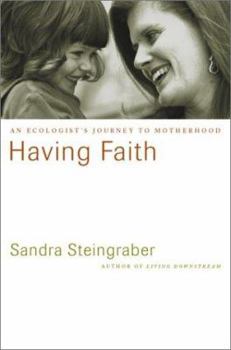
Having Faith: An Ecologist's Journey To Motherhood

Select Format
Select Condition 
Book Overview
A brilliant writer, first-time mother, and respected biologist, Sandra Steingraber tells the month-by-month story of her own pregnancy, weaving in the new knowledge of embryology, the intricate development of organs, the emerging architecture of the brain, and the transformation of the mother's body to nourish and protect the new life. At the same time, she shows all the hazards that we are now allowing to threaten each precious stage of development, including the breast-feeding relationship between mothers and their newborns. In the eyes of an ecologist, the mother's body is the first environment, the mediator between the toxins in our food, water, and air and her unborn child.Never before has the metamorphosis of a few cells into a baby seemed so astonishingly vivid, and never before has the threat of environmental pollution to conception, pregnancy, and even to the safety of breast milk been revealed with such clarity and urgency. In Having Faith, poetry and science combine ina passionate call to action.A Merloyd Lawrence Book
Format:Hardcover
Language:English
ISBN:0738204676
ISBN13:9780738204673
Release Date:October 2001
Publisher:Da Capo Press
Length:288 Pages
Weight:1.40 lbs.
Dimensions:9.0" x 1.0" x 6.3"
Customer Reviews
4 ratings
The top of the food chain
Published by Thriftbooks.com User , 21 years ago
You don't have to be pregnant to read this book. Steingraber is a poet and a scientist, sometimes both at once. From the very first paragraph of the preface, her poet's eye pulls us into the "ecosystem of the mother's body," and we share her amazement that she had "become a habitat. [Her] womb was an inland ocean with a population of one." Before she finishes, she has also realized that contrary to received opinion, "man" is not the top of the food chain: the nursing baby is! There are many more pithy and poetic observations, but I won't give any more of them away as they are a large part of the book's power to enchant. The science, especially the toxicology, is perhaps a little detailed for the expectant mother to assimilate in one reading, but one can always go back and take up one topic at a time, as Steingraber does in the course of the monthly chronology she follows. The early passages on the formation of the fetus are wonderful. The story of which cells start where and the landmarks of their migrations reads like a travel narrative. But then abruptly, S leaves behind the high art of embryology and her pregnancy "becomes empirical." Her toothbrush feels too big for her mouth, she is cranky, the bread of her sandwich is the wrong kind, and it's cut wrong. After some personal perspective on morning sickness, she once again adopts her scientist's perspective to investigate the causes of this nearly universal experience and why there is so little expert knowledge about it. We have soon learned more than we have ever heard about it before. In similar manner, alternately technical and lyrical, she covers both the science and personal experience of amniocentesis, congenital defects, fetal growth, prenatal education, birthing, and nursing-through to weaning. One can always find sources for the facts presented as well as avenues to find out more in the footnotes at the end of the book. At whatever speed one reads it, the book's message is very clear: the mother's body does a marvelous job of protecting the fetus from dangers that have existed on an evolutionary timescale, but there is now a new set of alarming environmental dangers that have intensified in the last several decades. Pregnant women must become aware of them and take steps to avoid the ones they can, and we all must work to change global policies that threaten us all. My 30-something daughter, who gave me the book, was born during what Steingraber calls the "heyday of the [natural childbirth] movement"-after Grantley Dick-Read and then Marjorie Karmel had reintroduced women into their own birth experiences but before seemingly innocuous technologies sabotaged awake births once again. The books we loved then, Karen Pryor's Nursing Your Baby, Niles Newton's Family Book of Childcare, and Robert Bradley's Husband Coached Childbirth, to name a few, are not up-to-date enough and they do not address the new generation of dangers in pregnancy and birth. Steingraber is up-to-dat
Top priority
Published by Thriftbooks.com User , 22 years ago
Sandra Steingraber, a trained scientist, tells the story of her pregnancy at age 38, weaving it into very readable science. She describes the day-to-day development of the fetus and how we KNOW at exactly what point birth defects are caused and, in many cases, which chemicals cause them. I was horrified to learn how many chemicals are being passed to our children through mothers' milk. And I can't stop telling my friends how the waters of the Arctic are the MOST polluted in the world, just the opposite of what you might think.This may be one of the most important books you will ever read. Like Rachel Carson's "Silent Spring", it should wake us up to the damage we are doing to our environment and to ourselves.The book is fascinating...and very, very scary. Every American, AND EVERY LEGISLATOR, should read it.
Beautiful and Necessary
Published by Thriftbooks.com User , 24 years ago
Sandra Steingraber is my new heroine. Her writing is magnificent, and her concerns very much my own. She manages to explain the inexplicable (we are poisoning our babies, and don't stop even when we see the evidence) in a way that does not frighten as much as persuade. She indeed has faith, and I am so grateful to her for facing these fearful realities during her pregnancy -- as she points out, if pregnant women don't face these things, who will? Her refrain "We shall not abstain" -- asking why it is pregnant women who must restrict themselves, not producers of toxics -- is common-sense political brilliance and unmasks the hypocrisy of a society that pretends to protect the vulnerable with technological might, but is really not interested when facts run counter to the fantasy of omnipotence. Her writing is so vivid that I burst into tears at the end of her labor-and-delivery story, as I do at any filmed depiction of birth. Thank you, Sandra.I'm giving it to all my friends, and sending it to some politicians!
A Must Read for Every Thinking Person on the Planet
Published by Thriftbooks.com User , 24 years ago
An avid reader and expectant mom, I can honestly say this book is the best I've read in a long time (especially among the mostly run-of-the-mill pregnancy and childbirth genre). The writing is beautiful, the story simultaneously heart-warming and compelling, and the science thorough and thought-provoking. Perhaps the most gripping part of the book is when Steingraber explains that unborn babies and nursing infants are at the top of the food chain, so toxins and pollutants reach them in greater quantities than any other species on the planet! While her language is not the least bit alarmest, the information she shares serves as a call to action to anyone who truly believes that "children are our future."
Copyright © 2026 Thriftbooks.com
Terms of Use | Privacy Policy | Do Not Sell/Share My Personal Information | Cookie Notice | Cookie Preferences | Accessibility Statement
ThriftBooks ® and the ThriftBooks ® logo are registered trademarks of Thrift Books Global, LLC
ThriftBooks ® and the ThriftBooks ® logo are registered trademarks of Thrift Books Global, LLC
