


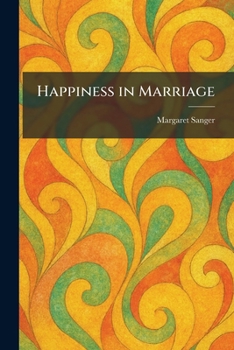
Happiness in Marriage

Select Format
Select Condition 
Book Overview
"Happiness in Marriage" is a seminal guide exploring the dynamics of marital success and sexual harmony from the perspective of a leading 20th-century reformer. Written by pioneering activist Margaret Sanger, this work provides practical and empathetic advice on building a stable and joyful partnership during a period of significant social transition. The book delves into the importance of mutual understanding, the role of physical intimacy, and the necessity of thoughtful family planning in fostering a healthy home life.
As a key figure in the reproductive rights movement, Sanger approaches the topic with a blend of scientific perspective and deep humanism, aiming to dispel the taboos surrounding sexuality in the early 1900s. "Happiness in Marriage" remains a significant historical document that reflects the evolving attitudes toward women's health and domestic relationships, advocating for a foundation of knowledge and respect within the union. It offers readers a window into the historical fight for sexual autonomy and the pursuit of domestic fulfillment, emphasizing that a happy marriage is built upon the pillars of health, equality, and shared responsibility.
This work has been selected by scholars as being culturally important, and is part of the knowledge base of civilization as we know it. This work was reproduced from the original artifact, and remains as true to the original work as possible. Therefore, you may see the original copyright references, library stamps (as most of these works have been housed in our most important libraries around the world), and other notations in the work.
This work is in the public domain in the United States of America, and possibly other nations. Within the United States, you may freely copy and distribute this work, as no entity (individual or corporate) has a copyright on the body of the work.
As a reproduction of a historical artifact, this work may contain missing or blurred pages, poor pictures, errant marks, etc. Scholars believe, and we concur, that this work is important enough to be preserved, reproduced, and made generally available to the public. We appreciate your support of the preservation process, and thank you for being an important part of keeping this knowledge alive and relevant.
Customer Reviews
ThriftBooks® and the ThriftBooks® logo are registered trademarks of Thrift Books Global, LLC
