


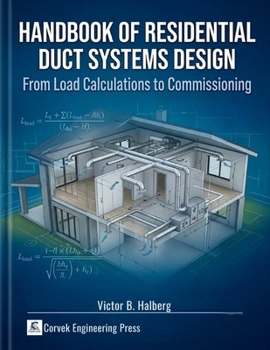
Handbook Of Residential Duct Systems Design: From Load Calculations to Commissioning

Most residential forced-air systems fail quietly. The equipment is installed, the air moves, and nobody notices for years, until the utility bills are persistently high, some rooms never reach comfort, or a test reveals that a third of delivered capacity is escaping through unsealed connections in a hot attic. These are not equipment failures. They are design failures: a duct system sized by rule of thumb rather than by calculation, sealed as an afterthought rather than to a standard, and handed over without a commissioning test.
Engineers and designers who want to break that pattern face a practical problem of their own: no single resource covers the entire residential duct design process at engineering depth. Standards manuals provide the procedure without the derivation. Short-course primers give vocabulary without calculation. Commercial-focused texts address different constraints than residential work requires. Until now, the gap between knowing enough to pass a course and understanding enough to design correctly has not been filled in a single volume.
This handbook fills that gap. Written for practising engineers, designers, and advanced students who work with residential forced-air systems, it covers the complete design workflow, from the heat load calculation that establishes how much capacity each room requires, through friction-rate and fitting-loss methods that size every duct segment, to commissioning procedures that verify the installed system delivers what the design specified.
Working through this handbook, the reader will develop the practical ability to:
● Apply heat load calculation principles and psychrometric analysis to determine room-by-room design airflows
● Select a design friction rate from available static pressure and total equivalent length, and size every supply and return duct segment using the equal friction method
● Calculate fitting losses using loss coefficients and equivalent lengths, identify the controlling run, and confirm the pressure budget
● Match blower and conditioning equipment to the duct system operating point using fan curves and system curves, and verify capacity under both heating and cooling conditions
● Specify duct materials, sealing methods, and insulation levels appropriate to the installation environment and applicable energy codes
● Design a return air system that maintains pressure balance across the building and prevents room pressurisation when interior doors close
● Integrate mechanical ventilation, zoning systems, acoustic requirements, and commissioning verification in a coordinated residential design methodology
Fifteen chapters cover: forced-air system fundamentals and pressure theory; heat load calculation; psychrometrics; airflow fundamentals and duct flow physics; duct sizing methods; fitting losses and system resistance; blower and equipment selection; duct materials, construction, and leakage; duct insulation and thermal performance; return air systems and pressure balance; ventilation integration; zoning and variable-speed equipment; acoustic design; commissioning, testing, and balancing; and a complete two-story residential case study integrating all prior methods.
Every equation is derived from stated assumptions. Every worked example carries units through every step with a boxed answer. Practice problems with answer keys close every chapter. Appendices contain psychrometric tables, friction chart reference, fitting loss coefficient tables, equivalent length tables, climate design data, and blank sizing worksheets.
This handbook is software-agnostic. A designer who understands why the friction rate is calculated the way it is, why total equivalent length is the correct input variable, and why return air sizing matters as much as supply sizing, will catch errors that automated tools cannot catch independently. The methods in this handbook are what the software imp
Customer Reviews
ThriftBooks ® and the ThriftBooks ® logo are registered trademarks of Thrift Books Global, LLC
