


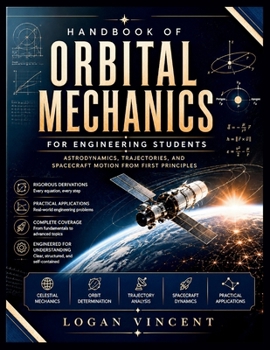
Handbook of Orbital Mechanics for Engineering Students: Astrodynamics, Trajectories, and Spacecraft Motion from First Principles

Many engineering students reach a specific, frustrating point in learning orbital mechanics: they can follow a derivation on the page, but they cannot yet use it - set up the physics, choose the right conservation law, and carry the units through to a checked numerical answer. This handbook is built to close that gap. Every derivation, from Newton's laws of motion through the full machinery of modern astrodynamics, is carried out with no skipped steps, and each is followed immediately by a fully worked, numerically solved engineering example that shows the method in action, in full, in real use.
Sixteen chapters carry the reader from the exact two-body solution through orbit determination, maneuver design, relative motion and rendezvous, interplanetary and lunar trajectories, perturbation theory, rocket propulsion, spacecraft attitude dynamics, satellite constellation design, low-thrust electric propulsion, and the current operational realities of a crowded orbital environment - all within one continuous, consistently structured reference.
What this handbook offers:
Full, unabridged derivations connecting Newtonian mechanics to the equations used throughout astrodynamics, with no steps skippedWorked numerical examples placed directly after each major derivation, showing a complete, checked solution methodEnd-of-chapter practice problems with worked answers, so progress can be checked without an instructorA consistent chapter structure - learning objectives, derivation, worked examples, problems - built for classroom use and self-study alikeA practical, connected workflow: describing an orbit, determining it from tracking data, maneuvering it, and accounting for real-world perturbationsA closing sequence connecting the mathematics to spacecraft engineering: propulsion, attitude control, constellation design, and orbital debris and space sustainabilityKey topics covered include the two-body problem and orbital elements; Kepler's equation and orbit propagation; coordinate transformations; preliminary orbit determination; orbital maneuvers including Hohmann transfers, bi-elliptic transfers, plane changes, and phasing; relative motion and rendezvous; interplanetary and lunar trajectory design; orbital perturbations; rocket vehicle dynamics and propulsion; spacecraft attitude dynamics and control; satellite constellation design; low-thrust and electric propulsion; and orbital debris and space sustainability.
This handbook is written for upper-level undergraduate engineering students - aerospace, astronautical, or mechanical - who have completed coursework in vector calculus, ordinary differential equations, and Newtonian mechanics and are ready to apply those tools to spacecraft trajectories. It is equally suited to graduate students encountering the subject for the first time, instructors seeking a course companion built around a consistent worked-example structure, and practicing engineers who want a rigorous, self-contained reference.
Readers who have felt the gap between a derivation and the ability to use it will find that gap addressed directly, chapter after chapter. Open the handbook and begin developing the knowledge needed to approach orbital mechanics, from first principles to real spacecraft engineering, with clarity and confidence.
Related Subjects
Engineering Science Science & Math Science & Scientists Science & Technology TechnologyCustomer Reviews
ThriftBooks ® and the ThriftBooks ® logo are registered trademarks of Thrift Books Global, LLC
