


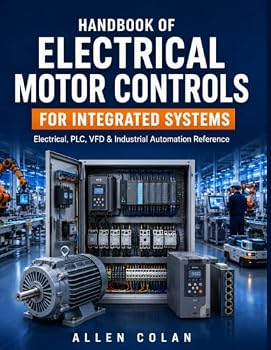
Handbook of Electrical Motor Controls for Integrated Systems: A Practical Guide to VFDs, PLCs, and Protection Devices in Modern Automation

You can derive an induction motor's equivalent circuit-but can you size the contactor that switches it, set the overload relay that protects it, configure the drive that controls its speed, and integrate the entire system into a plant control network?
For many capable engineers and engineering students, this is where theory ends and real industrial work begins.
Coursework may teach the physics of electrical machines, but the field demands much more: sizing motor branch circuits, selecting protective devices, choosing starting methods, coordinating protection, evaluating arc-flash hazards, designing control circuits, programming automation logic, configuring drives, and integrating motors into supervisory control systems.
Too often, these skills are learned piecemeal on the job.
Many references sit at one extreme or the other-either presenting abstract motor theory that never reaches the terminal block or offering basic troubleshooting procedures without explaining the engineering principles behind them.
This handbook closes that gap.
It develops the complete motor control system as one connected whole-from the physics of the machine to the supervisory network that monitors and controls it. Procedures are supported by calculations, practical engineering reasoning, realistic motor data, and recognized standards used in real installations.
WHAT THIS HANDBOOK HELPS YOU DO
- Size motor branch circuits and select protective devices using clear, code-based procedures
- Compare full-voltage, reduced-voltage, soft-start, and variable-frequency-drive starting methods and determine where each is appropriate
- Configure drive parameters governing acceleration, deceleration, speed limits, current, and motor protection
- Perform incident-energy calculations and determine appropriate protective equipment for electrical work
- Build start-stop, reversing, jogging, interlocking, and sequencing controls using both relay-based and programmable methods
- Specify motor control centres, establish industrial communications, and integrate equipment with operator and supervisory systems
- Commission completed motor-control installations and develop predictive-maintenance programmes that improve reliability
INSIDE THE HANDBOOK
Motor fundamentals and classification; AC induction and DC motor behaviour; contactors, starters, and overload relays; manual and magnetic control circuits; reduced-voltage starting; soft starters; variable-frequency drives; pulse-width modulation; motor protection and fault coordination; arc-flash hazard analysis; electrical safety; programmable controllers; operator interfaces; alarm management; motor control centres; supervisory control; industrial networking; commissioning; and predictive maintenance.
WHO THIS BOOK IS FOR
This handbook is written for practising electrical, controls, and automation engineers; engineering technologists and technicians; and upper-level engineering students who already understand basic electrical circuit theory and want to connect that knowledge-rigorously and practically-to modern industrial motor control.
Move beyond understanding how motors work.
Learn how to size, protect, control, program, integrate, commission, and maintain complete motor control systems with confidence.
Customer Reviews
ThriftBooks ® and the ThriftBooks ® logo are registered trademarks of Thrift Books Global, LLC
