


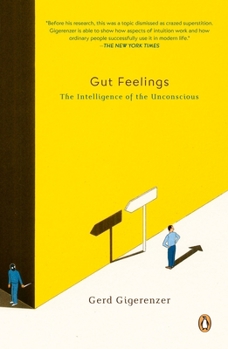
Gut Feelings: The Intelligence of the Unconscious


Select Format
Select Condition 
Book Overview
Why is split second decision-making superior to deliberation? Gut Feelings delivers the science behind Malcolm Gladwell's Blink. Reflection and reason are overrated, according to renowned psychologist Gerd Gigerenzer. Much better qualified to help us make decisions is the cognitive, emotional, and social repertoire we call intuition, a suite of gut feelings that have evolved over the millennia specifically for making decisions. Gladwell drew heavily on Gigerenzer's research. But Gigerenzer goes a step further by explaining just why our gut instincts are so often right. Intuition, it seems, is not some sort of mystical chemical reaction but a neurologically based behavior that evolved to ensure that we humans respond quickly when faced with a dilemma ( BusinessWeek ).
Format:Paperback
Language:English
ISBN:0143113763
ISBN13:9780143113768
Release Date:June 2008
Publisher:Penguin Publishing Group
Length:288 Pages
Weight:0.43 lbs.
Dimensions:0.5" x 5.1" x 7.7"
Age Range:18 years and up
Grade Range:Grade 12 and higher
Related Subjects
Anatomy Anatomy & Physiology Behavioral Sciences Biological Sciences Biology & Life Sciences Cognitive Cognitive Psychology Health, Fitness & Dieting Health, Fitness & Dieting History & Philosophy Politics & Social Sciences Psychoanalysis Psychology Psychology & Counseling Science Science & Math Science & Scientists Science & TechnologyCustomer Reviews
4 ratings
Many books like this these days
Published by Thriftbooks.com User , 17 years ago
There are many books like this these days. That talk about neurology, or psychology or even economics and business and intersect it with how we think and behave. Many of them talk about the same experiment and regurgitate the same conclusions, but as a bonus "Gut Feelings" ties many concepts together, this book presents these data in a way that is better. It's hard to explain that without spending a long time on this review, so I'm going to give a simple example that got me thinking which is why I liked this book so well. It was about how a baseball player catches a fly ball and it opens up a discussion, or thoughts, on just what we think we are. A baseball player was criticized by his coach to catch fly balls better by running over as fast as possible to where he thinks the ball is going to land and then look up and catch the ball. This is what I think of as the God's eye view of the world. Human beings are build in God's image, and so we have these computer like brains that can solve differential equations that are almost magical, and we need to take advantage of them. There is no telling how much damage has been done to people by this viewpoint, but the baseball player is one example. It turns out that when he followed his coaches expert advice he catches fewer balls. Huh? The coach ... the authority, hmmm ... very few of us really know what is going on inside us as we are live our lives, and this book slaps you in the face over and over about over-thinking, and trying to be a computer, and offers simpler methods to use instead. We catch balls by a simple heuristic (hope I spelled that right), by using our "gut". We fixate on the ball and try to keep the ball at a constant angle to us in the air and intersect that angle as the balls closes in. A simple elegant linear solution that evolution provided our simple brains to use. There are so many good examples of this kind of simple elegant direct thinking about thinking that I heartily recommend this book. In fact I intend to read more of the author's works.
the substance missing from Blink
Published by Thriftbooks.com User , 18 years ago
when reading Gladwell's Blink, I kept hoping that by the end of the book something about how my brain worked would be revealed. Well, I got a sense that the Blink-like decisions I made on a daily basis are more common than I thought and with a wider scope (racism etc). What was incredibly disappointing about Blink was that I walked away with no more insight. yes some examples were articulated, but this in some ways was not really the promise of the book. the promise of walking away with something concrete is fulfilled in Gut feelings, which is almost like a response to Blink; the author is saying to Gladwell "this is how its done, young jedi!". Get this book if you want to know why you fight with your spouse or why you get along with them. get this book if you want to understand how to improve yourself by having more insight into how your brain is wired. get this book and his other book on Risk, and you will become a better person. not a cheap promise.
Why We Do What We Do: An Intelligent and Genuinely Informative Account
Published by Thriftbooks.com User , 19 years ago
I once saw some slow motion film of some world-class cricketers. Some of the best batsmen closed their eyes in the face of a ball hurtling towards them at over 100 miles per hour. Yet they still hit the ball with remarkable accuracy. There are similar puzzles in baseball. You can describe the trajectory of the ball with all kinds of clever mathematics, but the clever outfielder knows little about such arcane mysteries. He watches the flight of the ball and automatically keeps the angle between his eyes and the ball constant. A neuroscientist consulting with a major car manufacturer showed them a way to develop a very simple proximity sensor based on the nervous system of a locust. When locusts swarm, they somehow avoid bumping into each other. It turns out that the circuit involves only four neurons. But saves the locusts - and weekend motorists - an ocean of hurt. The cricketer, the baseball player and the locust represent three examples of ways in which the nervous system uses simple rules to allow us to functions in complex situations. If we had to use all of our brainpower to solve every problem we would never get out of bed. Gerd Gigerenzer is a well-known and influential figure in neuroscience: he directs the Center for Adaptive Behavior and Cognition at the Max Plank Institute for Human Development in Berlin, Germany. He is a superb presenter who is much in demand at major international conferences and he has won numerous awards including the American Association for the Advancement of Science Prize for Behavioral Science Research. He is also the author of the seminal work: Adaptive Thinking: Rationality in the Real World (Evolution and Cognition Series). In this book he discusses the way in which simple rules form the basis of much of what goes on beneath the level of conscious awareness and may also form the basis of intuition. I slightly disagree with this last point: what Gerd is really talking about is instinct rather than intuition. The publicity surrounding this new book makes much of Gerd's role in providing some of the science and theoretical underpinning of Malcolm Gladwell's excellent book and perennial favorite: Blink: The Power of Thinking Without Thinking. On this occasion the marketers have got it right. Gerd Gigerenzer illustrates his book with many fascinating examples that show the accuracy of instinct. He also makes an important and often-overlooked point: instinctual decisions are not impulsive: they have their own brain-based rationale. The rules and principles that guide instinct are unsophisticated but surprisingly accurate. This is why people can often make good choices on topics outside their area of expertise. I have seen this with top level scientists and marketers, who can look at something about which they know very little, but still come up with remarkably perceptive answers. There has also been much recent discussion about the success of private investors who pick their own stocks and shares, when com
Yes we are guided by our gut feelings.
Published by Thriftbooks.com User , 19 years ago
When one of our government official expressed his gut feelings about an important issue we all were in an uproar. In our conscious mind we deny the value of gut feelings. In reality we all guided by our gut feelings first and seek out the "facts" afterwards to support our view. This book is an excellent eye opener for people whom are open minded and not in denial of our inherent internal mechanism to make decisions.
Copyright © 2026 Thriftbooks.com
Terms of Use | Privacy Policy | Do Not Sell/Share My Personal Information | Cookie Notice | Cookie Preferences | Accessibility Statement
ThriftBooks ® and the ThriftBooks ® logo are registered trademarks of Thrift Books Global, LLC
ThriftBooks ® and the ThriftBooks ® logo are registered trademarks of Thrift Books Global, LLC
