


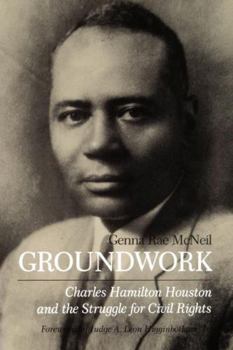
Groundwork: Charles Hamilton Houston and the Struggle for Civil Rights


Select Format
Select Condition 
Book Overview
"A classic. . . . It] will make an extraordinary contribution to the improvement of race relations and the understanding of race and the American legal process."--Judge A. Leon Higginbotham, Jr., from... This description may be from another edition of this product.
Format:Hardcover
Language:English
ISBN:081227878X
ISBN13:9780812278781
Release Date:May 1983
Publisher:University of Pennsylvania Press
Length:344 Pages
Weight:1.53 lbs.
Dimensions:6.0" x 9.0"
Customer Reviews
1 rating
Early History of civil rights litigation
Published by Thriftbooks.com User , 23 years ago
Charles Houston was the father of Brown v. Board of Ed--but tragically died in 1950, just as this historic litigation was getting underway.It is hard to imagine any other lawyer--not to mention a Black lawyer in the 1940's who could have had a greater impact on the law as we know it. A truly remarkable human being. He not only gave birth to the NAACP's school desegregation campaign, but he also broke ground in employment discrimination, union rights, and many other developing fields of law; not to mention founding the modern day Howard Law School, which has served as the incubator for virtually all fo the civil rights litigation in the 20th Century, running a private practice, writing a regular newpaper column, and holding public office (the D.C. school board).Ms. McRae thankfully spends only a brief time on his family history, and then gets right to the story of Houston's legal career. However, one story from Houston's formative years is instructive: When Houston served in the (segregated) Army (in WWI), he was appointed to decide the fate of a Black soldier. His investigation showed that the alleged infraction had been blown out of proportion. However, he was ordered by his superiors to find the soldier guilty, and sentence him to hard time in the brig. As a result of this experience, Houston vowed to learn the law, so that he could devote his life to ensuring that Blacks could never again be subjected to this type of injustice. He succeded beyond anyone's wildest dreams.The moral? I suppose the racist superior officer lived to regret the day that he set Charles Houston on the path of justice--a [ath which ultimately lead to the destruction of legally enforced racial segregation in America--talk about a short sighted victory for racism!Anyone who is interested in reading the story of a true (but underappreciated) American hero would do well to read this book!
Copyright © 2026 Thriftbooks.com
Terms of Use | Privacy Policy | Do Not Sell/Share My Personal Information | Cookie Notice | Cookie Preferences | Accessibility Statement
ThriftBooks ® and the ThriftBooks ® logo are registered trademarks of Thrift Books Global, LLC
ThriftBooks ® and the ThriftBooks ® logo are registered trademarks of Thrift Books Global, LLC
