


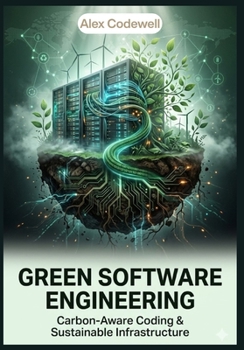
Green Software Engineering: Carbon-Aware Coding & Sustainable Infrastructure
No Customer Reviews

What if your next deployment melted a gram of ice?
Every line of code you ship consumes fossil fuels. Behind every API call stand server halls humming with heat, undersea cables pulsing with light, and cooling towers evaporating millions of gallons of water. Data center workloads will double by 2030, driven by AI training clusters and relentless digitization. The efficiency gains of Moore's Law have been swallowed by expansion-faster hardware simply means we build more, and absolute emissions keep climbing.
This book recalibrates your engineering instincts for a carbon-constrained world. The Green Software Foundation's Software Carbon Intensity (SCI) specification now treats carbon as a concrete metric, as measurable as latency or uptime. You will learn to read electricity grids like load balancers, understanding marginal carbon intensity, duck curves, and geographic optimization. You will profile code not merely for speed, but for watts, and optimize for the renewable energy mix of the grid at 2:00 AM versus 2:00 PM. You will calculate the operational and embodied carbon of your services, distinguish between the energy cost of a cached response versus a database query, and learn why temporal shifting of compute workloads is now a core infrastructure skill.
Inside, you will find:
- Why your caching strategy might be heating a coal-fired power plant - How to read an electricity grid like a load balancer, chasing lower carbon intensity across time zones - The real thermal cost of an unoptimized SQL query, measured in grams of CO₂ equivalent - Why ARM chipsets and AI model compression are now architectural necessities - How to right-size clusters for actual load rather than peak anxiety - When to shift compute temporally and geographically toward renewable abundance - How algorithmic complexity translates directly to energy draw and thermal output
The standards are set. The APIs exist. The science is settled. What remains is the work of implementation.
Call to Action: Pull the lever with open eyes. Start building software that respects the physics behind the screen.
Every line of code you ship consumes fossil fuels. Behind every API call stand server halls humming with heat, undersea cables pulsing with light, and cooling towers evaporating millions of gallons of water. Data center workloads will double by 2030, driven by AI training clusters and relentless digitization. The efficiency gains of Moore's Law have been swallowed by expansion-faster hardware simply means we build more, and absolute emissions keep climbing.
This book recalibrates your engineering instincts for a carbon-constrained world. The Green Software Foundation's Software Carbon Intensity (SCI) specification now treats carbon as a concrete metric, as measurable as latency or uptime. You will learn to read electricity grids like load balancers, understanding marginal carbon intensity, duck curves, and geographic optimization. You will profile code not merely for speed, but for watts, and optimize for the renewable energy mix of the grid at 2:00 AM versus 2:00 PM. You will calculate the operational and embodied carbon of your services, distinguish between the energy cost of a cached response versus a database query, and learn why temporal shifting of compute workloads is now a core infrastructure skill.
Inside, you will find:
- Why your caching strategy might be heating a coal-fired power plant - How to read an electricity grid like a load balancer, chasing lower carbon intensity across time zones - The real thermal cost of an unoptimized SQL query, measured in grams of CO₂ equivalent - Why ARM chipsets and AI model compression are now architectural necessities - How to right-size clusters for actual load rather than peak anxiety - When to shift compute temporally and geographically toward renewable abundance - How algorithmic complexity translates directly to energy draw and thermal output
The standards are set. The APIs exist. The science is settled. What remains is the work of implementation.
Call to Action: Pull the lever with open eyes. Start building software that respects the physics behind the screen.
Format:Paperback
Language:English
ISBN:B0GZK2932P
ISBN13:9798195529345
Release Date:May 2026
Publisher:Independently Published
Length:378 Pages
Weight:1.32 lbs.
Dimensions:0.8" x 6.7" x 9.6"
Customer Reviews
0 rating
Copyright © 2026 Thriftbooks.com
Terms of Use | Privacy Policy | Do Not Sell/Share My Personal Information | Cookie Policy | Cookie Preferences | Accessibility Statement
ThriftBooks ® and the ThriftBooks ® logo are registered trademarks of Thrift Books Global, LLC
ThriftBooks ® and the ThriftBooks ® logo are registered trademarks of Thrift Books Global, LLC
