


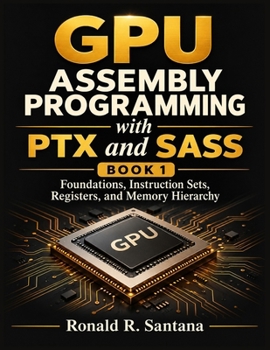
GPU Assembly Programming with PTX and SASS Book 1: Foundations, Instruction Sets, Registers, and Memory Hierarchy

Ever wondered what your GPU is actually doing while your kernel runs?
Have you written code that should be fast, only to watch it perform far below the hardware's potential? Have you opened a disassembly listing and struggled to understand what the instructions mean? This book helps you move beyond guesswork and understand how your code executes at the machine level.
Who Is This Book For?
Designed for performance engineers, compiler and tooling developers, kernel researchers, and advanced students who already understand parallel programming and want to explore GPU execution at a deeper level. No prior assembly experience is required.
What You Will Learn in This First Volume
How modern GPUs are structured, from multiprocessors to individual execution units.How warps execute, diverge, and reconverge, and why architectural differences matter.How kernels move from source code through virtual instructions to native machine code.How to read disassembly listings and connect individual instructions to their source code.How to write and test inline assembly and handcrafted instructions safely.How reduced-precision formats and matrix instructions affect performance and accuracy.How register allocation, spilling, and instruction scheduling influence execution.How registers, shared memory, caches, and global memory interact, and how to optimize memory bandwidth.Why This Book Is Different
Every major concept is supported by complete, runnable programs, precise tests, and repeatable performance measurements. You will learn not only how GPU instructions work but also how to verify their behaviour on your own hardware. The emphasis is on practical understanding, technical accuracy, and measurable results.
A Note on the Two-Volume Series
This is Book 1 of a two-volume series, covering GPU architecture, execution, instruction sets, registers, scheduling, and the memory hierarchy.
Book 2 builds directly on these foundations, exploring asynchronous pipelines, memory ordering, profiling, debugging, multi-device systems, and comprehensive engineering case studies.
Read this volume independently to develop practical low-level GPU programming skills, or continue with Book 2 for a broader understanding of GPU machine-level programming and performance engineering.
Stop guessing what your GPU is doing. Learn to read, understand, and optimize the machine itself.
Customer Reviews
ThriftBooks ® and the ThriftBooks ® logo are registered trademarks of Thrift Books Global, LLC
