


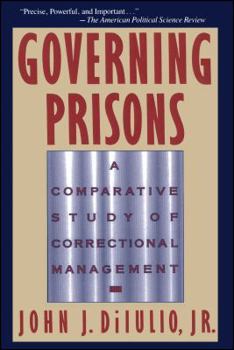
Governing Prisons: A Comparative Study of Correctional Management


Select Format
Select Condition 
Book Overview
A comparative study of correctional management that illustrates how the introduction of internal governing systems in prisons can encourage civilized behavior, provide order, and enforce punishment. Challenging the accepted notions about prisons, Governing Prisons argues for the necessity of ensuring these facilities are made safely humane. John J. Dilulio argues that the key to better prisons is a highly disciplined constitutional government that involves employing prison managers that are able toconrol themselves while working to control the inmates.
Format:Paperback
Language:English
ISBN:0029078830
ISBN13:9780029078839
Release Date:June 1990
Publisher:Free Press
Length:364 Pages
Weight:1.22 lbs.
Dimensions:0.9" x 6.0" x 9.0"
Customer Reviews
3 ratings
Governing Prisons
Published by Thriftbooks.com User , 16 years ago
Interesting look into the prison systems within three different states in three different geographic areas. Marked similarities in their approaches as well as where they found their own varisions to approach the over-crowding as well common prison management issues.
The Seminal Book on Correctional Administration
Published by Thriftbooks.com User , 20 years ago
John DiIulio's seminal work on correctional administration is timeless, and it is just as relevant today as it was when it was written in the late 1980s. Governing Prisons continues to be an excellent text for graduate courses in criminal justice and business administration. Too, it should be required reading for prison administrators.
The One Reference for Those Interested in Safe and Humane Pr
Published by Thriftbooks.com User , 27 years ago
If I could reccomend only one book on prison management this is the one. The author critically examines and compares three large state prison systems; California, Michigan, and Texas. He identifies the fundamental philosophies that govern each system and shows the practical results of each. The "Michigan Responsability Model", The "Texas Control Model", and the California Confused Model which is merely a mixture of the Michigan and Texas philosophies. All prison systems in the U.S. are varients of the two models or mixtures of one degree or another as is California. The study speaks for itself as to which is the superior system, if the goal is safe and humane prisons that provide as effective rehabilitation as is possible. Must reading for prison administrators, professors, politicians, and anyone else interested in proper prison management.
Copyright © 2026 Thriftbooks.com
Terms of Use | Privacy Policy | Do Not Sell/Share My Personal Information | Cookie Policy | Cookie Preferences | Accessibility Statement
ThriftBooks ® and the ThriftBooks ® logo are registered trademarks of Thrift Books Global, LLC
ThriftBooks ® and the ThriftBooks ® logo are registered trademarks of Thrift Books Global, LLC
