


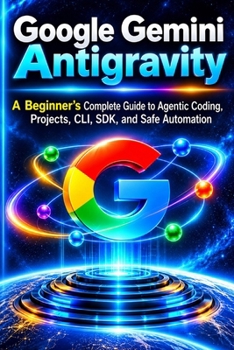
Google Gemini Antigravity: A Beginner's Complete Guide to Agentic Coding, Projects, CLI, SDK, and Safe Automation

Build with AI confidently, not by guessing, but by understanding the workflow.
Google Gemini Antigravity is an agentic development platform that can help you explore a codebase, plan changes, write and review code, run tests, inspect browser behavior, create artifacts, and coordinate longer-running engineering work. Its capabilities are powerful, but the real skill is knowing how to give an agent the right context, the right boundaries, and the right evidence requirements.
Google Gemini Antigravity: A Beginner's Complete Guide takes you from your first project to practical, safety-conscious development. You will learn how the Antigravity App, CLI, IDE extensions, Python SDK, and managed API fit together-and when each surface is the right choice. Inside the book, you will learn how to:
Understand the agentic coding mental model: inspect, plan, act, observe, and verify.Install and configure Antigravity while recording versions, accounts, quotas, project boundaries, and model choices.Write precise coding requests with context, acceptance criteria, non-goals, stopping rules, and human approval points.Use projects, conversations, worktrees, plans, diffs, walkthroughs, screenshots, and other artifacts as reviewable evidence.Work productively from the CLI and supported IDEs without losing control of the files and commands an agent can access.Build local Python agents with system instructions, tools, structured results, policies, hooks, persistence, and subagents.Design managed API interactions that handle remote environments, tools, budgets, incomplete runs, retries, and failure states.Apply least privilege to terminal commands, files, URLs, MCP servers, plugins, network access, and credentials.Use browser verification, Chrome DevTools, screenshots, recordings, unit tests, integration tests, and regression checks.Operate agentic workflows with team conventions, scheduled tasks, lifecycle hooks, observability, rollback plans, and release gates.The book includes practical Python, Bash, JSON, YAML, CLI, REST, testing, policy, and prompt examples. Snippets are intentionally small so you can inspect, adapt, and test them in your own environment. Version-sensitive examples are clearly identified, because model names, package interfaces, plan availability, and product behavior can change.
This guide is written for developers, students, technical leads, educators, and curious builders who want a clear path into AI-assisted software development. You do not need to be an expert programmer to begin. You do need a willingness to review results, protect sensitive data, test behavior, and keep a human in control of consequential actions. By the end, you will have more than a collection of prompts. You will have a repeatable way to choose a surface, define a bounded task, guide an agent, inspect its artifacts, verify its work, and decide whether a change is ready to release.
Customer Reviews
ThriftBooks ® and the ThriftBooks ® logo are registered trademarks of Thrift Books Global, LLC
