


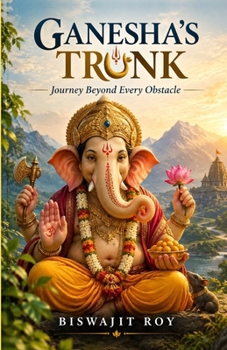
Ganesha's Trunk: Journey Beyond Every Obstacle
No Customer Reviews

GANESHA'S TRUNK takes readers on a fascinating journey through his birth, transformation, family, rivalries, marriage, prosperity, and role as Vighnaharta-the Remover of Obstacles. Each part of Ganesha's form reveals a deeper lesson about wisdom, desire, sacrifice, success, relationships, and resilience. At its heart is the mystery of the curved trunk: life rarely follows a straight path. When circumstances change, true wisdom is not to break, but to bend, adapt, and continue toward one's purpose. Book Summary:
Ganesha is one of the most beloved figures in Hindu tradition, recognized across the world by his elephant head, curved trunk, broken tusk, large ears, great belly, and tiny mouse beneath him. But behind this unforgettable form lies a deeper story-one filled with mystery, loss, transformation, wisdom, family, desire, prosperity, and the endless struggle between human plans and the unpredictable path of life. Before he became the god people remembered before every important beginning, Ganesha was a child created by Parvati to guard her door. When Shiva arrived and demanded entry, the child refused to move because he did not know who stood before him. The confrontation ended in tragedy. Ganesha lost his life, and Shiva later restored him with the head of an elephant. What first appeared to be a terrible transformation became the beginning of a greater destiny. The elephant head came to represent wisdom, memory, patience, strength, dignity, and the ability to move through difficult paths. As Ganesha grows, every part of his unusual form begins revealing a hidden meaning. His large ears teach him to listen before judging. His small eyes teach concentration and the ability to see beyond appearances. His powerful trunk teaches control-the wisdom to know when strength is necessary and when gentleness is greater. Its curved shape becomes an even deeper mystery. In different traditions, left- and right-curving trunks are associated with different forms of energy, discipline, worship, and spiritual practice. Ganesha gradually realizes that the curve itself carries a message: life does not always move in a straight line. His rivalry with his brother Kartikeya teaches him that speed is not always the same as progress. His broken tusk, remembered through different traditions, becomes a symbol of sacrifice, determination, knowledge, and the ability to turn loss into purpose. His tiny mouse reveals another mystery. Beneath the greatest god sits one of the smallest creatures, representing restless desire, curiosity, temptation, and the wandering mind. Ganesha does not destroy it. He rides it, showing that true mastery comes not from destroying desire but from learning how to direct it. As Ganesha matures, Riddhi and Siddhi enter his story through traditions that connect them with prosperity, fulfillment, accomplishment, wisdom, and spiritual attainment. His growing family introduces a new challenge. Wealth and success can be blessings, but they can also become traps. Through associations with Shubha and Labha, Ganesha discovers that prosperity can create generosity or greed, while success can produce confidence or pride. He learns that possessing wealth is different from being possessed by it. Marriage brings another unexpected lesson. The god who can overcome enormous obstacles discovers that relationships cannot always be solved through power or logic. Companionship requires listening, patience, humility, compromise, forgiveness, and understanding. Ganesha learns that sometimes the greatest obstacle is not outside a person but inside the mind. Eventually, people begin invoking Ganesha before journeys, marriages, examinations, businesses, ceremonies, and new beginnings.
Ganesha is one of the most beloved figures in Hindu tradition, recognized across the world by his elephant head, curved trunk, broken tusk, large ears, great belly, and tiny mouse beneath him. But behind this unforgettable form lies a deeper story-one filled with mystery, loss, transformation, wisdom, family, desire, prosperity, and the endless struggle between human plans and the unpredictable path of life. Before he became the god people remembered before every important beginning, Ganesha was a child created by Parvati to guard her door. When Shiva arrived and demanded entry, the child refused to move because he did not know who stood before him. The confrontation ended in tragedy. Ganesha lost his life, and Shiva later restored him with the head of an elephant. What first appeared to be a terrible transformation became the beginning of a greater destiny. The elephant head came to represent wisdom, memory, patience, strength, dignity, and the ability to move through difficult paths. As Ganesha grows, every part of his unusual form begins revealing a hidden meaning. His large ears teach him to listen before judging. His small eyes teach concentration and the ability to see beyond appearances. His powerful trunk teaches control-the wisdom to know when strength is necessary and when gentleness is greater. Its curved shape becomes an even deeper mystery. In different traditions, left- and right-curving trunks are associated with different forms of energy, discipline, worship, and spiritual practice. Ganesha gradually realizes that the curve itself carries a message: life does not always move in a straight line. His rivalry with his brother Kartikeya teaches him that speed is not always the same as progress. His broken tusk, remembered through different traditions, becomes a symbol of sacrifice, determination, knowledge, and the ability to turn loss into purpose. His tiny mouse reveals another mystery. Beneath the greatest god sits one of the smallest creatures, representing restless desire, curiosity, temptation, and the wandering mind. Ganesha does not destroy it. He rides it, showing that true mastery comes not from destroying desire but from learning how to direct it. As Ganesha matures, Riddhi and Siddhi enter his story through traditions that connect them with prosperity, fulfillment, accomplishment, wisdom, and spiritual attainment. His growing family introduces a new challenge. Wealth and success can be blessings, but they can also become traps. Through associations with Shubha and Labha, Ganesha discovers that prosperity can create generosity or greed, while success can produce confidence or pride. He learns that possessing wealth is different from being possessed by it. Marriage brings another unexpected lesson. The god who can overcome enormous obstacles discovers that relationships cannot always be solved through power or logic. Companionship requires listening, patience, humility, compromise, forgiveness, and understanding. Ganesha learns that sometimes the greatest obstacle is not outside a person but inside the mind. Eventually, people begin invoking Ganesha before journeys, marriages, examinations, businesses, ceremonies, and new beginnings.
Format:Paperback
Language:English
ISBN:B0HJS1Q32X
ISBN13:9798174305977
Release Date:September 2026
Publisher:Independently Published
Length:118 Pages
Weight:0.27 lbs.
Dimensions:0.3" x 5.1" x 7.8"
Customer Reviews
0 rating
Copyright © 2026 Thriftbooks.com
Terms of Use | Privacy Policy | Do Not Sell/Share My Personal Information | Cookie Notice | Cookie Preferences | Accessibility Statement
ThriftBooks ® and the ThriftBooks ® logo are registered trademarks of Thrift Books Global, LLC
ThriftBooks ® and the ThriftBooks ® logo are registered trademarks of Thrift Books Global, LLC
