


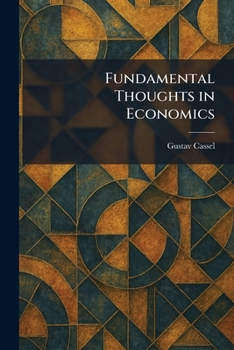
Fundamental Thoughts in Economics

"Fundamental Thoughts in Economics" is a foundational treatise by the influential Swedish economist Gustav Cassel, distilling the essential principles that govern economic systems. Written during a transformative period in economic thought, the work provides a clear and rigorous exposition of Cassel's theoretical framework, which places the concept of scarcity at the heart of economic life. Cassel argues that the primary function of economics is the management of limited resources, leading to his renowned analysis of price formation and the necessity of a rational pricing mechanism.
In this work, Cassel moves away from classical value theories to emphasize a more functional approach to economic science. He explores the role of money, the nature of interest, and the dynamics of international exchange, laying the groundwork for many modern concepts in macroeconomics and monetary policy. Known for his clarity of thought and ability to synthesize complex ideas, Cassel presents a vision of economics that is both analytical and deeply practical.
This book remains a significant contribution to the history of economic thought, offering readers insight into the intellectual developments of the early 20th century. "Fundamental Thoughts in Economics" is an essential read for students of economic history, political economy, and anyone interested in the core logical structures that underpin global markets.
This work has been selected by scholars as being culturally important, and is part of the knowledge base of civilization as we know it. This work was reproduced from the original artifact, and remains as true to the original work as possible. Therefore, you may see the original copyright references, library stamps (as most of these works have been housed in our most important libraries around the world), and other notations in the work.
This work is in the public domain in the United States of America, and possibly other nations. Within the United States, you may freely copy and distribute this work, as no entity (individual or corporate) has a copyright on the body of the work.
As a reproduction of a historical artifact, this work may contain missing or blurred pages, poor pictures, errant marks, etc. Scholars believe, and we concur, that this work is important enough to be preserved, reproduced, and made generally available to the public. We appreciate your support of the preservation process, and thank you for being an important part of keeping this knowledge alive and relevant.
Customer Reviews
ThriftBooks ® and the ThriftBooks ® logo are registered trademarks of Thrift Books Global, LLC
