


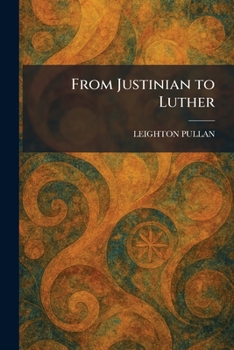
From Justinian to Luther

Select Format
Select Condition 
Book Overview
"From Justinian to Luther" offers a profound and scholarly investigation into the religious and political evolution of Europe, spanning the centuries from the late antiquity of the Byzantine Empire to the dawn of the Protestant Reformation. Written by Leighton Pullan, this work provides a comprehensive overview of the Christian Church's development throughout a pivotal millennium. The narrative begins with the reign of Emperor Justinian, whose legal and ecclesiastical structures defined the relationship between Church and State for generations, and follows the trajectory of Christian thought through the complex landscape of the Middle Ages.
The book examines critical themes such as the rise of the papacy, the intellectual influence of scholasticism, and the recurring tensions between secular rulers and spiritual authorities. Pullan offers detailed insights into the cultural and theological shifts that characterized the medieval mind, illustrating how the Church served as the central pillar of Western civilization. By exploring the lives of influential saints, philosophers, and political leaders, the author provides a nuanced understanding of the historical forces at play. "From Justinian to Luther" remains an essential resource for readers interested in the transformation of the late antique world into the early modern era and the enduring legacy of the medieval Church.
This work has been selected by scholars as being culturally important, and is part of the knowledge base of civilization as we know it. This work was reproduced from the original artifact, and remains as true to the original work as possible. Therefore, you may see the original copyright references, library stamps (as most of these works have been housed in our most important libraries around the world), and other notations in the work.
This work is in the public domain in the United States of America, and possibly other nations. Within the United States, you may freely copy and distribute this work, as no entity (individual or corporate) has a copyright on the body of the work.
As a reproduction of a historical artifact, this work may contain missing or blurred pages, poor pictures, errant marks, etc. Scholars believe, and we concur, that this work is important enough to be preserved, reproduced, and made generally available to the public. We appreciate your support of the preservation process, and thank you for being an important part of keeping this knowledge alive and relevant.
Customer Reviews
ThriftBooks ® and the ThriftBooks ® logo are registered trademarks of Thrift Books Global, LLC
