


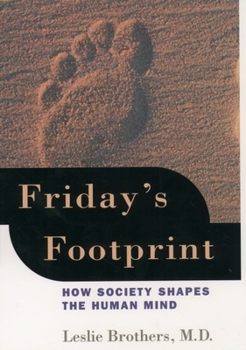
Friday's Footprint: How Society Shapes the Human Mind

Select Format
Select Condition 
Book Overview
A psychiatrist who has received international recognition for her research on the neural basis of primate social cognition, Leslie Brothers, M.D., offers here a major argument about the social dimension of the human brain, drawing on both her own work and a wealth of information from research laboratories, neurosurgical clinics, and psychiatric wards.
Brothers offers the tale of Robinson Crusoe as a metaphor for neuroscience's classic (and flawed) notion of the brain: a starkly isolated figure, working, praying, writing alone. But the famous castaway of literature, she notes, came from society and returned to society. So too with our brains: they have evolved a specialized capacity for exchanging signals with other brains--they are designed to be social. This can be seen in the brain's sensitive attunement to the meanings of facial expressions and physical gestures and the way it assigns mental lives to physical bodies--a feat we too often take for granted. (Brothers describes fascinating case studies that show that certain kinds of brain damage can destroy a patient's ability to interpret faces, leaving him or her with the sense that they are surrounded by zombies.) She takes us down to the level of the individual neuron, exploring the response of brain cells to social events. Perhaps most important, she connects neuroscience, psychiatry, and sociology as never before, showing how our daily interaction creates an organized social world--a network of brains that generates meaningful behavior and thought. Emotion, the sense of self--the entire spectrum of the mind--has no existence outside of a social context.
Brothers conducts her argument with grace and style. By broadening our approach to the brain, this groundbreaking book makes an important contribution to our understanding of the human mind.
Brothers offers the tale of Robinson Crusoe as a metaphor for neuroscience's classic (and flawed) notion of the brain: a starkly isolated figure, working, praying, writing alone. But the famous castaway of literature, she notes, came from society and returned to society. So too with our brains: they have evolved a specialized capacity for exchanging signals with other brains--they are designed to be social. This can be seen in the brain's sensitive attunement to the meanings of facial expressions and physical gestures and the way it assigns mental lives to physical bodies--a feat we too often take for granted. (Brothers describes fascinating case studies that show that certain kinds of brain damage can destroy a patient's ability to interpret faces, leaving him or her with the sense that they are surrounded by zombies.) She takes us down to the level of the individual neuron, exploring the response of brain cells to social events. Perhaps most important, she connects neuroscience, psychiatry, and sociology as never before, showing how our daily interaction creates an organized social world--a network of brains that generates meaningful behavior and thought. Emotion, the sense of self--the entire spectrum of the mind--has no existence outside of a social context.
Brothers conducts her argument with grace and style. By broadening our approach to the brain, this groundbreaking book makes an important contribution to our understanding of the human mind.
Format:Hardcover
Language:English
ISBN:0195101030
ISBN13:9780195101034
Release Date:September 1997
Publisher:Oxford University Press
Length:208 Pages
Weight:1.15 lbs.
Dimensions:9.4" x 0.7" x 6.3"
Customer Reviews
1 rating
All The World's A Stage
Published by Thriftbooks.com User , 27 years ago
A book which should help to shift the paradigm of consciousness from isolationist to interactivist, "Friday's Footprint" is a masterpiece in challenging the old ideas of brain science. We naturally think of consciousness (and mind) as isolated objects like our brains, but that is too limiting a perspective, given the almost completely social nature of the mind. Language and social interaction have conditioned us well, meaning that there is no longer any point in trying to put our finger on "consciousness" when it is just as much "out there" in society as inside our heads.Some people particularly fearful of change may want to hold onto their belief in the representational notion of truth (that one's opinion can somehow "correspond" to a "reality" out there), but Dr. Brothers leaves no room for such beliefs in the socially-conditioned brain: "Language simply embodies the shared beliefs and practices of the community of language users." (p. 101) We're simply acting out narratives and roles, which is normal, but let's not assume that such socially acceptable terms as thoughts, emotions, self, mind and so on really have a separate, definite existence.Dr. Brothers' book requires as much of a shift in one's thinking as it did the brain researchers who discovered socially responsive cells; as it does those "believers" in the strict objectivity of science who must realize that science is socially and culturally influenced; as it did Robinson Crusoe, alone for years when he finally found proof of the existence of another human being: Friday's footprint.
Copyright © 2026 Thriftbooks.com Terms of Use
| Privacy Policy | Do Not
Sell/Share My Personal Information | Cookie Policy | Cookie Preferences | Accessibility Statement
ThriftBooks® and the ThriftBooks® logo are registered trademarks of Thrift Books Global, LLC
ThriftBooks® and the ThriftBooks® logo are registered trademarks of Thrift Books Global, LLC
