


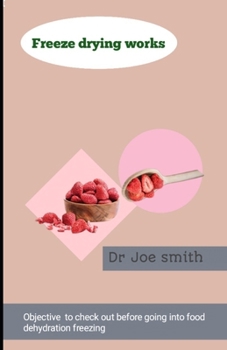
Freeze drying works: Objective to check out before going into food dehydration freezing
No Customer Reviews

Dehydration via freezing, also known as cryodessication, is the process of removing water from an object or substance by freezing it at extremely low temperatures. This process is commonly used in the preservation of food, pharmaceuticals, and even biological materials. It is an effective method of preserving and storing various goods, as well as a useful technique in various industries. The process of dehydration via freezing involves exposing an object or substance to subzero temperatures, typically ranging from -20 C to -80 C, in order to solidify the water within it. This solidification causes the water to transform into ice crystals, which are then removed from the object or substance through a process known as sublimation. Sublimation occurs when a substance transitions directly from a solid to a gas without passing through a liquid state. The use of dehydration via freezing in the preservation of food dates back to ancient times, with evidence of humans using ice and snow to preserve their food as early as prehistoric times. This method was particularly useful for preserving fish and meat in colder regions, where natural freezing temperatures were readily available. However, with the advancement of technology, cryodessication has become a more controlled and efficient process. One of the main benefits of dehydration via freezing is that it effectively deactivates any microorganisms present in the object or substance. This is particularly important in the preservation of food, as it prevents the growth of harmful bacteria and extends the shelf life of the food. By removing the water, which is essential for the survival and growth of microorganisms, dehydration via freezing acts as a natural preservative.
Format:Paperback
Language:English
ISBN13:9798327619548
Release Date:June 2024
Publisher:Independently Published
Length:34 Pages
Weight:0.11 lbs.
Dimensions:0.1" x 5.5" x 8.5"
Customer Reviews
0 rating
Copyright © 2026 Thriftbooks.com
Terms of Use | Privacy Policy | Do Not Sell/Share My Personal Information | Cookie Notice | Cookie Preferences | Accessibility Statement
ThriftBooks ® and the ThriftBooks ® logo are registered trademarks of Thrift Books Global, LLC
ThriftBooks ® and the ThriftBooks ® logo are registered trademarks of Thrift Books Global, LLC
