


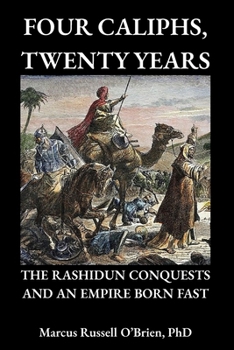
Four Caliphs, Twenty Years: The Rashidun Conquests and an Empire Born Fast

History remembers the astonishing conquests. This book asks the more important question: how did they happen at all?
When the Prophet Muhammad died in 632, the Muslim community appeared dangerously fragile. Its authority barely extended beyond western Arabia, tribal loyalties were uncertain, and the world's two superpowers-the Byzantine and Sassanian Empires-still dominated the Near East. Within just twenty years, that small community had conquered Syria, Egypt, Iraq, Persia, and lands stretching from North Africa to Central Asia, reshaping world history with breathtaking speed.
In Four Caliphs, Twenty Years, historian Marcus Russell O'Brien traces the extraordinary rise of the Rashidun Caliphate through the lives and leadership of Abu Bakr, Umar, Uthman, and Ali. Moving chronologically from the crisis following Muhammad's death to the First Fitna that shattered the unity of the early caliphate, the book examines the battles, political decisions, administrative innovations, and personal rivalries that forged-and nearly destroyed-one of history's fastest-growing empires.
Drawing on surviving ancient sources and modern scholarship, O'Brien presents a balanced historical narrative that neither avoids controversy nor reduces complex events to simple legends. He explores the remarkable military successes of the Rashidun armies while placing them within the wider context of exhausted rival empires, fragile institutions, and competing claims to legitimacy that continue to shape the Islamic world today.
A compelling work of historical nonfiction, Four Caliphs, Twenty Years is the story of an empire born with astonishing speed-and of the immense human, political, and religious costs of building a state before its foundations were fully secure.
Customer Reviews
ThriftBooks ® and the ThriftBooks ® logo are registered trademarks of Thrift Books Global, LLC
