


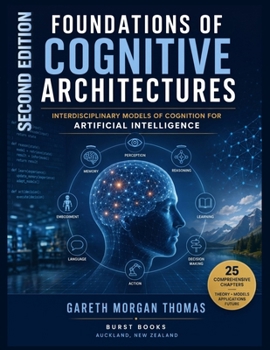
Foundations of Cognitive Architectures: Interdisciplinary Models of Cognition for Artificial Intelligence

What separates a genuinely intelligent system from a collection of impressive algorithms?
It is not enough for a machine to recognize images, retrieve information, generate language, or solve isolated problems. Real intelligence requires perception, memory, learning, reasoning, planning, communication, and action to operate as one coordinated system.
That is the problem cognitive architectures are designed to solve.
Foundations of Cognitive Architectures provides a comprehensive guide to the theories, mechanisms, models, and engineering principles behind integrated intelligent systems. Moving from the foundations of cognitive science to artificial general intelligence, robotics, language processing, multi-agent systems, neuroscience, security, ethics, and verification, this book explains how complete cognitive systems are organized-and why architectural choices determine what those systems can ultimately achieve.
Rather than treating cognitive architectures as a list of competing names, this book examines the mechanisms beneath them: how information is represented, how memories are formed and retrieved, how actions are selected, how learning changes future behaviour, how limited resources are managed, and how intelligent systems can be tested, trusted, and improved.
Inside, you will discover:
- How cognitive architectures differ from narrow AI models, algorithms, and individual software systems
- How perception, attention, memory, reasoning, learning, planning, and action are coordinated across a continuous cognitive cycle
- The strengths and limitations of symbolic, subsymbolic, neural, probabilistic, and hybrid approaches
- Detailed examinations of major architectures including ACT-R, Soar, CLARION, Sigma, LIDA, Leabra, SPAUN, EPIC, OpenCog, ICARUS, CHREST, Nengo, DUAL, COGENT, and SAL
- How cognitive architectures relate to artificial general intelligence and the pursuit of broadly capable autonomous systems
- How embodied cognition shapes robotics, sensorimotor control, navigation, and human-robot interaction
- How cognitive systems process language, maintain context, communicate, and operate within multi-agent environments
- How developmental, evolutionary, biologically inspired, and self-modifying architectures approach adaptation
- How scalability, real-time processing, security, trust, ethics, culture, and context affect practical system design
- How cognitive architectures can be verified, validated, debugged, compared, and deployed
- How psychological and neuroscientific theories can be translated into executable computational mechanisms
- Where the field is heading as cognitive architectures converge with machine learning, large language models, robotics, and emerging AI technologies
The book also includes equations, architecture diagrams, worked examples, comparison frameworks, implementation guidance, review material, design patterns, and practical checklists for evaluating cognitive systems.
Whether you are an AI researcher, cognitive scientist, software engineer, roboticist, psychologist, neuroscientist, student, or technical practitioner, this book will give you a structured framework for understanding how intelligent systems are built from the inside out.
Stop studying intelligence as a disconnected collection of techniques.
Learn how the mechanisms fit together.
Get Foundations of Cognitive Architectures and develop a deeper, more rigorous understanding of the systems attempting to model-and ultimately create-integrated intelligence.
Customer Reviews
ThriftBooks ® and the ThriftBooks ® logo are registered trademarks of Thrift Books Global, LLC
