


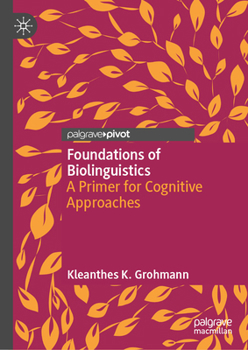
Foundations of Biolinguistics: A Primer for Cognitive Approaches

This book outlines the basic tenets of the biolinguistic approach, framed in the form of five "foundational questions" which mirror the well-known "problems" identified in Chomsky's (1986) Knowledge of Language plus two additional questions that have crystallized since (see e.g. Boeckx & Grohmann 2007). While often construed with generative investigations of human language, the author argues that biolinguistics should not be just another term for generative grammar; the biolinguistic approach to the study of language will thus be presented in a broader perspective by inspecting and dissecting the foundational questions, with particular reference to cognitive linguistics. The novelty is in the gradient distinction between cognitive linguistics in the narrow vs. broad sense, denoting different understandings of the cognitive basis of the science of language. This book will be of interest to students and scholars in fields including linguisitcs, philosophy, cognitive science, computer science and biology.
Customer Reviews
ThriftBooks ® and the ThriftBooks ® logo are registered trademarks of Thrift Books Global, LLC
