


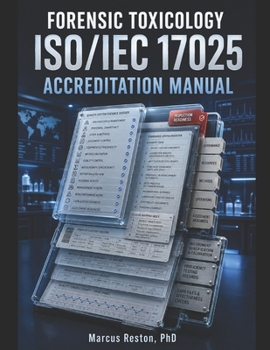
Forensic Toxicology ISO/IEC 17025 Accreditation Manual: Build an Audit-Ready Quality System, Prepare for Laboratory Assessments, Correct Nonconformiti
No Customer Reviews

Turn ISO 17025 Requirements Into Evidence an Assessor Can Sample:
This forensic toxicology accreditation manual gives laboratory leaders a practical ISO 17025 laboratory accreditation guide for building a system that works on an ordinary day-not a binder assembled before an assessment. Your Policies May Be Written. Can You Prove the Work Matches Them?
You may already have standards, SOPs, forms, and experienced staff. The hard part is connecting them. Which requirement applies? Who owns the control? What record proves it ran? Where does the requirement enter the toxicology workflow? Missing links create findings, emergency rework, delayed casework, and reports that are harder to defend. This manual helps you find those links before an assessor does. Build Readiness Around Source Tiers and Objective Evidence
The book uses two repeatable habits. Source-tier discipline separates base requirements, accreditor rules, published standards, recommendations, laboratory choices, and teaching examples. The objective-evidence habit ties every control to a dated record an assessor can inspect. Together, they turn scattered requirements into an owned, scheduled, evidence-producing quality system. What You Can Put to Work
- Map scope, authority, responsibilities, deputies, and quality objectives.
- Control documents, records, revisions, retention, and external standards.
- Build role-specific competency files, authorizations, monitoring, and remediation.
- Strengthen specimen acceptance, chain of custody, equipment control, and traceability.
- Plan method validation, measurement uncertainty, quality control, and case review.
- Run risk-based internal audits, management review, CAPA, and effectiveness checks.
- Prepare personnel, records, and response workflows for assessment day.
- Adapt fourteen reusable templates through your laboratory's own governance.
Use the annual readiness calendar, 90-60-30 assessment plans, evidence-request log, and post-assessment tracker to keep preparation visible, assigned, and on schedule every cycle. Follow the Full Laboratory Workflow
Across twenty-three chapters, the manual moves from accreditation orientation through governance, personnel competence, technical operations, reporting, assurance, nonconforming work, corrective action, and assessment response. Five integrated case walkthroughs show how a custody weakness, QC trend, validation deviation, unsupported authorization, and repeated transcription error move from detection to defensible closure. Built for Working Forensic Toxicology Laboratories
The material is written for quality managers, laboratory directors, technical leaders, accreditation coordinators, senior analysts, and authorized signatories in postmortem and human-performance toxicology. Completed fictional records show what strong evidence looks like. Weak examples and reviewer commentary show why familiar shortcuts fail. Decision tools, audit prompts, likely assessment questions, and corrective pathways keep each chapter tied to daily work. Useful Whether Your Assessment Is Months Away or Already Scheduled
You do not need to read every standard from scratch or rebuild every form at once. Start with the scope and standards-status register. Trace one control to its owner and evidence. Then use the completed examples and templates to repair the next gap. The manual also marks its boundaries: it does not reproduce standards, certify conformity, promise accreditation, or replace current requirements from your accreditor. Build the Records Before You Need to Defend Them
Add this forensic laboratory quality management manual to your quality office and begin turning requirements into records, controls, and assessment-ready evidence today.
This forensic toxicology accreditation manual gives laboratory leaders a practical ISO 17025 laboratory accreditation guide for building a system that works on an ordinary day-not a binder assembled before an assessment. Your Policies May Be Written. Can You Prove the Work Matches Them?
You may already have standards, SOPs, forms, and experienced staff. The hard part is connecting them. Which requirement applies? Who owns the control? What record proves it ran? Where does the requirement enter the toxicology workflow? Missing links create findings, emergency rework, delayed casework, and reports that are harder to defend. This manual helps you find those links before an assessor does. Build Readiness Around Source Tiers and Objective Evidence
The book uses two repeatable habits. Source-tier discipline separates base requirements, accreditor rules, published standards, recommendations, laboratory choices, and teaching examples. The objective-evidence habit ties every control to a dated record an assessor can inspect. Together, they turn scattered requirements into an owned, scheduled, evidence-producing quality system. What You Can Put to Work
- Map scope, authority, responsibilities, deputies, and quality objectives.
- Control documents, records, revisions, retention, and external standards.
- Build role-specific competency files, authorizations, monitoring, and remediation.
- Strengthen specimen acceptance, chain of custody, equipment control, and traceability.
- Plan method validation, measurement uncertainty, quality control, and case review.
- Run risk-based internal audits, management review, CAPA, and effectiveness checks.
- Prepare personnel, records, and response workflows for assessment day.
- Adapt fourteen reusable templates through your laboratory's own governance.
Use the annual readiness calendar, 90-60-30 assessment plans, evidence-request log, and post-assessment tracker to keep preparation visible, assigned, and on schedule every cycle. Follow the Full Laboratory Workflow
Across twenty-three chapters, the manual moves from accreditation orientation through governance, personnel competence, technical operations, reporting, assurance, nonconforming work, corrective action, and assessment response. Five integrated case walkthroughs show how a custody weakness, QC trend, validation deviation, unsupported authorization, and repeated transcription error move from detection to defensible closure. Built for Working Forensic Toxicology Laboratories
The material is written for quality managers, laboratory directors, technical leaders, accreditation coordinators, senior analysts, and authorized signatories in postmortem and human-performance toxicology. Completed fictional records show what strong evidence looks like. Weak examples and reviewer commentary show why familiar shortcuts fail. Decision tools, audit prompts, likely assessment questions, and corrective pathways keep each chapter tied to daily work. Useful Whether Your Assessment Is Months Away or Already Scheduled
You do not need to read every standard from scratch or rebuild every form at once. Start with the scope and standards-status register. Trace one control to its owner and evidence. Then use the completed examples and templates to repair the next gap. The manual also marks its boundaries: it does not reproduce standards, certify conformity, promise accreditation, or replace current requirements from your accreditor. Build the Records Before You Need to Defend Them
Add this forensic laboratory quality management manual to your quality office and begin turning requirements into records, controls, and assessment-ready evidence today.
Format:Paperback
Language:English
ISBN:B0H8ZXQ7C1
ISBN13:9798187453030
Release Date:July 2026
Publisher:Independently Published
Length:278 Pages
Weight:1.43 lbs.
Dimensions:0.6" x 8.5" x 11.0"
Customer Reviews
0 rating
Copyright © 2026 Thriftbooks.com
Terms of Use | Privacy Policy | Do Not Sell/Share My Personal Information | Cookie Policy | Cookie Preferences | Accessibility Statement
ThriftBooks ® and the ThriftBooks ® logo are registered trademarks of Thrift Books Global, LLC
ThriftBooks ® and the ThriftBooks ® logo are registered trademarks of Thrift Books Global, LLC
