


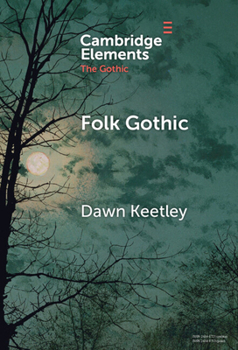
Folk Gothic
No Customer Reviews

Folk Gothic begins with the assertion that a significant part of what has been categorised as folk horror is more accurately and usefully labelled as Folk Gothic. Through the modifier 'folk', Folk Gothic obviously shares with folk horror its deployment (and frequent fabrication) of diegetic folklore. Folk Gothic does not share, however, folk horror's incarnate monsters, its forward impetus across spatial and ontological boundaries and the shock and repulsion elicited through its bodily violence. The author argues that the Folk Gothic as a literary, televisual and cinematic formation is defined by particular temporal and spatial structures that serve to forge distinctly nonhuman stories. In emphasising these temporal and spatial structures - not literal 'folk' and 'monsters' - the Folk Gothic tells stories that foreground land and 'things', consequently loosening the grip of anthropocentrism.
Format:Hardcover
Language:English
ISBN:1009467816
ISBN13:9781009467810
Release Date:February 2024
Publisher:Cambridge University Press
Length:78 Pages
Weight:0.61 lbs.
Dimensions:0.3" x 6.0" x 9.0"
Customer Reviews
0 rating
Copyright © 2026 Thriftbooks.com
Terms of Use | Privacy Policy | Do Not Sell/Share My Personal Information | Cookie Policy | Cookie Preferences | Accessibility Statement
ThriftBooks ® and the ThriftBooks ® logo are registered trademarks of Thrift Books Global, LLC
ThriftBooks ® and the ThriftBooks ® logo are registered trademarks of Thrift Books Global, LLC
