


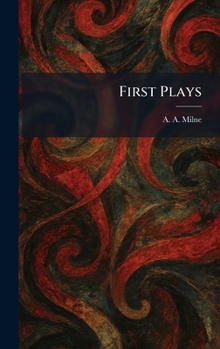
First Plays

"First Plays" is a captivating collection of early dramatic works by the celebrated British author A. A. Milne. While widely known for his later beloved children's literature, Milne's prowess as a playwright shines in this anthology, showcasing the wit, charm, and keen social observation that defined his theatrical career. The volume includes five distinct plays: "Wurzel-Flummery," "The Lucky One," "The Boy Comes Home," "Belinda," and "The Red Feathers."
Spanning genres from lighthearted comedy to poignant domestic drama, these works offer a fascinating glimpse into early 20th-century English society. "Wurzel-Flummery" explores the absurdity of inheritance and social status through a clever satirical lens, while "Belinda" presents an "April folly" centered on the nuances of romance and identity. In "The Boy Comes Home," Milne touches on more serious themes regarding the generation gap and the impact of the First World War on family dynamics. Each play is characterized by Milne's signature dialogue-crisp, intelligent, and perpetually engaging. For readers, scholars, and performers alike, "First Plays" serves as an essential introduction to the sophisticated humor and dramatic craftsmanship of one of England's most versatile and enduring writers.
This work has been selected by scholars as being culturally important, and is part of the knowledge base of civilization as we know it. This work was reproduced from the original artifact, and remains as true to the original work as possible. Therefore, you may see the original copyright references, library stamps (as most of these works have been housed in our most important libraries around the world), and other notations in the work.
This work is in the public domain in the United States of America, and possibly other nations. Within the United States, you may freely copy and distribute this work, as no entity (individual or corporate) has a copyright on the body of the work.
As a reproduction of a historical artifact, this work may contain missing or blurred pages, poor pictures, errant marks, etc. Scholars believe, and we concur, that this work is important enough to be preserved, reproduced, and made generally available to the public. We appreciate your support of the preservation process, and thank you for being an important part of keeping this knowledge alive and relevant.
Related Subjects
DramaCustomer Reviews
ThriftBooks ® and the ThriftBooks ® logo are registered trademarks of Thrift Books Global, LLC
