


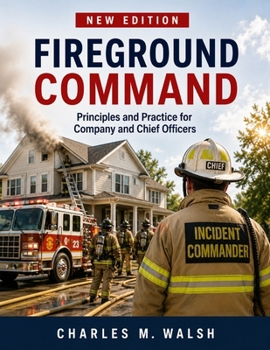
Fireground Command New Edition: Principles and Practice for Company and Chief Officers

Fireground command demands the integration of leadership, strategic thinking, fire behavior, building construction, risk management, communications, and operational coordination, yet few resources bring these critical disciplines together into one complete guide for today's fire service leaders.
Firefighters advancing into company officer or chief officer roles often discover that command knowledge is scattered across leadership manuals, incident command references, fire behavior texts, and operational standards. Some books focus heavily on theory, while others emphasize procedures without explaining the reasoning behind critical command decisions. The result is a familiar gap between understanding command concepts in the classroom and confidently applying them during fast-moving, high-risk emergencies where every decision carries life-and-death consequences.
This book closes that gap with a comprehensive, practice-focused guide that develops fireground command from foundational principles through complex, multi-agency incident management. Every chapter connects command doctrine with practical application, helping readers understand not only what decisions should be made, but why experienced incident commanders make them under pressure.
Inside, you will:
- Master the principles of modern fireground command, leadership, and strategic decision-making from the first-arriving company through large-scale incident management.
- Develop effective size-up techniques, risk-benefit analysis, and tactical planning that support safer, faster, and more effective operational decisions.
- Build confidence in establishing, organizing, expanding, and transferring command using Incident Command System (ICS) principles and proven command structures.
- Understand how fire behavior, building construction, smoke conditions, ventilation, and structural collapse indicators influence command strategy and firefighter safety.
- Apply command principles across residential, commercial, mixed-use, high-rise, wildland, hazardous materials, and mass-casualty incidents using practical operational frameworks.
- Strengthen leadership during Mayday events, firefighter rescue operations, rapid intervention deployments, and other high-risk emergency situations.
- Learn from realistic case studies, operational examples, chapter summaries, review questions, and practice exercises designed to reinforce critical command skills and improve decision-making.
Key topics covered include command doctrine, leadership under pressure, incident command qualifications, fire behavior, building construction, size-up, communications, risk management, command transfer, residential and commercial fire operations, high-rise command, firefighter survival, rapid intervention, wildland and wildland-urban interface incidents, hazardous materials response, mass-casualty management, unified command, multi-agency coordination, and post-incident leadership.
This book is written for firefighters preparing for promotion, company officers, chief officers, fire instructors, academy cadets, emergency response leaders, and fire service professionals seeking to strengthen their command capabilities through practical knowledge and proven operational principles.
If you want to develop the confidence to lead with authority, make sound tactical decisions under pressure, and command emergency incidents with professionalism and precision, this comprehensive guide provides the knowledge, strategies, and practical foundation needed to become a more capable and effective fireground commander. Add it to your professional library and build your command expertise one chapter at a time.
Customer Reviews
ThriftBooks ® and the ThriftBooks ® logo are registered trademarks of Thrift Books Global, LLC
