


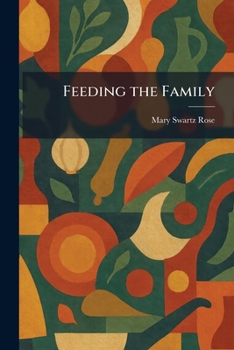
Feeding the Family

Select Format
Select Condition 
Book Overview
"Feeding the Family" is a foundational guide to nutrition and meal planning designed to promote the health and well-being of every family member. Written by Mary Swartz Rose, a pioneer in the field of dietetics, this comprehensive work bridges the gap between scientific nutritional research and the practical needs of the daily kitchen. The book offers detailed guidance on tailoring diets to different life stages, including infancy, childhood, adolescence, adulthood, and old age, ensuring that individual physiological needs are met through balanced and wholesome food choices.
Beyond simple recipes, the text delves into the caloric and nutritional requirements of various occupations and lifestyles, providing readers with the tools to construct economical and nourishing menus. It addresses the essential roles of vitamins, minerals, and macronutrients in the human diet, making complex nutritional concepts accessible to the layperson. With its focus on preventive health through proper eating habits, "Feeding the Family" serves as an enduring resource for those interested in the history of domestic science, home economics, and the evolution of modern dietary standards. This work remains a significant contribution to the literature of public health and domestic management.
This work has been selected by scholars as being culturally important, and is part of the knowledge base of civilization as we know it. This work was reproduced from the original artifact, and remains as true to the original work as possible. Therefore, you may see the original copyright references, library stamps (as most of these works have been housed in our most important libraries around the world), and other notations in the work.
This work is in the public domain in the United States of America, and possibly other nations. Within the United States, you may freely copy and distribute this work, as no entity (individual or corporate) has a copyright on the body of the work.
As a reproduction of a historical artifact, this work may contain missing or blurred pages, poor pictures, errant marks, etc. Scholars believe, and we concur, that this work is important enough to be preserved, reproduced, and made generally available to the public. We appreciate your support of the preservation process, and thank you for being an important part of keeping this knowledge alive and relevant.
Customer Reviews
ThriftBooks® and the ThriftBooks® logo are registered trademarks of Thrift Books Global, LLC
