


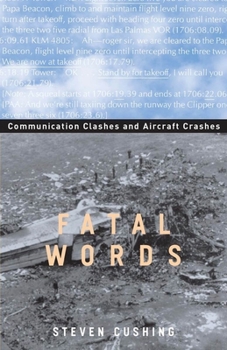
Fatal Words: Communication Clashes and Aircraft Crashes


Select Format
Select Condition 
Book Overview
On March 27, 1977, 583 people died when KLM and Pan Am 747s collided on a crowded, foggy runway in Tenerife, the Canary Islands. The cause, a miscommunication between the pilot and the air traffic controller. The pilot radioed, "We are now at takeoff," meaning that the plane was lifting off, but the tower controller misunderstood and thought the plane was waiting on the runway. In Fatal Words, Steven Cushing explains how miscommunication has led to dozens of aircraft disasters, and he proposes innovative solutions for preventing them. He examines ambiguities in language when aviation jargon and colloquial English are mixed, when a word is used that has different meanings, and when different words are used that sound alike. To remedy these problems, Cushing proposes a visual communication system and a computerized voice mechanism to help clear up confusing language. Fatal Words is an accessible explanation of some of the most notorious aircraft tragedies of our time, and it will appeal to scholars in communications, linguistics, and cognitive science, to aviation experts, and to general readers.
Format:Paperback
Language:English
ISBN:0226132013
ISBN13:9780226132013
Release Date:May 1997
Publisher:University of Chicago Press
Length:176 Pages
Weight:0.55 lbs.
Dimensions:0.6" x 5.5" x 8.5"
Related Subjects
Airport Automotive Aviation Commercial Communication Communication & Journalism Communications Engineering Health, Fitness & Dieting Health, Fitness & Dieting Language Arts Neuropsychology Politics & Government Psychology Public Affairs & Policy Safety & First Aid Social Services & Welfare Technology Transportation Words, Language & GrammarCustomer Reviews
1 rating
For Linguists, Pilots, and Air Traffic Controllers Only
Published by Thriftbooks.com User , 21 years ago
"Fatal Words" is a totally unique book, and it is impossible to pigeonhole. Is it a book on transformational grammar for linguists? Is it a book of miscommunications, and the resultant impact on aviation safety? Is it a book on computer programming? Actually, it's all three. I bought the book to read from an air safety standpoint, given that I am an airline pilot. I found the book very interesting but very tough reading in parts, and occasionally a bit unfocused. The book is in three parts, plus a very long technical appendix. The first part concerns itself with language use, and includes many examples from not only NTSB Accident Reports, but from ASRS 'Callback' (published by NASA) that were from incidents. Although I generally agree on all his points and would highly encourage all pilots and Air Traffic Controllers to heed his warnings (and to examine their speech for potential errors of the types Dr. Cushing points out) there are a couple of minor exceptions I take to statements he makes or assumptions he has about pilot-controller language use, particularly in reference to the word "hold" in the Air California gear up landing accident. Overall, though, it is a brilliant analysis. Part two is similar to part one in that it focuses on communication problems not related to language (numbers, radios, etc.). Both parts one and two are four chapters long per part. The analysis in part two is my favorite part of the book, and relates issues such as transposed digits, limitations of radios, the 10 versus 11 problem so common in altitude violations, etc. This is the part that has unparalleled insight into pilot-controller communications interactions and the foibles that can result. Every pilot and controller should read part two. Part three deals with proposed solutions to the problem, and in this section he details a machine that can interpret language, check grammar, sentence structure, and meaning before allowing a message to be transmitted. He admits that this is a long time in the future, and proposes a short term data link system. I realize the machine he developed, while excellent research, is a prototype, but with all respect to the efforts of Dr. Cushing and his graduate students, I feel he may be barking up the wrong tree. The constructs of the machine are so complex, and the commands and menu options he envisions are so unwieldy that I can't imagine a machine that checks grammar and content of every transmission, and won't (at least to my understanding) let any non-database words pass its parser, being fast enough to keep up with the Air Traffic Control needs of Jackson, MS, much less LaGuardia at five in the afternoon. I am absolutely not closed minded on this subject, and am a huge proponent of CPDLC, which was in testing by American Airlines and Miami Center last year. I would love to see a revised edition of the book (it was published in 1994) with the latest technology added and the computer programs he developed to be updated and poss
Copyright © 2025 Thriftbooks.com
Terms of Use | Privacy Policy | Do Not Sell/Share My Personal Information | Cookie Policy | Cookie Preferences | Accessibility Statement
ThriftBooks ® and the ThriftBooks ® logo are registered trademarks of Thrift Books Global, LLC
ThriftBooks ® and the ThriftBooks ® logo are registered trademarks of Thrift Books Global, LLC
