


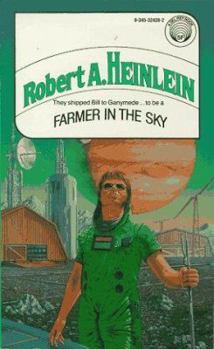


Book Overview
Published in condensed form in Boy's life magazine under title: Satellite scout.
Format:Mass Market Paperback
Language:English
ISBN:0345324382
ISBN13:9780345324382
Release Date:February 1985
Publisher:Del Rey Books
Length:221 Pages
Weight:0.30 lbs.
Dimensions:0.7" x 4.3" x 6.9"
Customer Reviews
5 ratings
Old but still works on the young
Published by Thriftbooks.com User , 16 years ago
Makes a good bedtime story for a Cub Scout who is respectful enough of Boy Scouts to give this story about their farming on Ganymede an attentive listen. The slang is dated but my youthful listener doesn't seem to notice or care. The details of trying to farm on a moon-planet with no soil of its own, an artificial atmosphere, and few trees holds both our attentions. When the quakes begin, the excitement builds. Doesn't hurt that we can now examine photographs of the real Ganymede and wonder if anything Heinlein imagined would be remotely possible.
Loved it as a boy
Published by Thriftbooks.com User , 16 years ago
I loved this book when I was a boy. I'm sure young readers today will like it just as well.
It ought to seem dated, but somehow it doesn't
Published by Thriftbooks.com User , 17 years ago
This is among the set of "classic" Heinlein novels written in the 1950s for juvenile readers -- what nowadays we'd call "young adults." By definition, this was written for kids, so a parent can feel comfortable in handing the book to a child (even a bright 8-year-old... certainly I'd have read it at that age). The book (or a shorter version) was commissioned for Boy's Life, the magazine of the Boy Scouts, so it has a huge thread of "scouting is great, you betcha!" The protagonist, Bill, gets involved in starting a scout troop on the space flight to become a colonist on Ganymede, the Jupiter moon. The basic story is a modified "Hero's Journey" in which teenager Bill (and his father) emigrate as space colonists and must cope with all the challenges that entails. Although Heinlein later earned a reputation for tedious exposition, in this case it works very well. He goes through all the steps that would be necessary to terraform a moon (given some base assumptions/guesses about the evolution of science), for example, and how astrogation would work on the spaceship. The result is that the young reader will learn (painlessly) that Science Matters; you might have a discussion with her about what did/didn't turn out to be true (not to mention, "So why *haven't* we colonized space?" -- good question, kid). There are a few anachronistic giggles; for example, in the first few pages, Bill comes back from a consumer/scout airflight over California and his dad suggests he figure something out with his slide rule. It's likely that the one thing in the book that a child might need a definition for is that slide rule. Farmer in the Sky isn't among the greatest of Heinlein's juveniles (much less his general fiction), but it's solidly good -- and holds up rather well, to my surprise. Heinlein was a master of just plain good taletelling, and can carry along anyone -- at least me -- with the thread of "And THEN what happened?!" to make me turn pages.
In one word, spectacular.
Published by Thriftbooks.com User , 27 years ago
Farmer in the Sky is the first Heinlein book I ever read, and is easily one of the best. I first read it 8 years ago, when i was 10, and can still pick it up today, and enjoy it just as much as the first time i read it, even though it was written with a child in mind. The characters are solid, as is the plot, creating an unforgetable story.
Brave New Worlds
Published by Thriftbooks.com User , 27 years ago
A wonderful futuristic adventure; the "pioneering of space" theme of Heinlein is again the focus of this novel. The terraforming ideas--while wildly speculative--add to the drama of place (Jupiter's frigid moon Ganeymede). Why this is ever considered a "juvenile" is beyond me; Heinlein treated his young readers as smart, sophisticated adults. Get this book and regain your sense of wonder, spirit of individuality, and your birthright to explore the unknown!
Copyright © 2026 Thriftbooks.com Terms of Use
| Privacy Policy | Do Not
Sell/Share My Personal Information | Cookie Policy | Cookie Preferences | Accessibility Statement
ThriftBooks® and the ThriftBooks® logo are registered trademarks of Thrift Books Global, LLC
ThriftBooks® and the ThriftBooks® logo are registered trademarks of Thrift Books Global, LLC
