


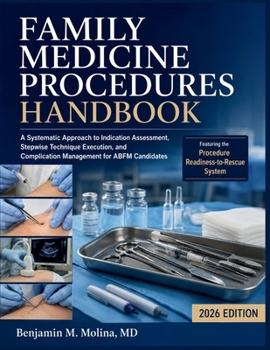
Family Medicine Procedures Handbook 2026: A Systematic Approach to Indication Assessment, Stepwise Technique Execution, and Complication Management fo

Built for clinicians who perform procedures across office, urgent care, rural, hospital-based, pediatric, and emergency settings, this handbook connects procedural anatomy, patient selection, sterile preparation, analgesia, monitoring, documentation, and complication rescue into one practical system. It centers family medicine procedures on the clinical decision that matters most: not only how to perform the procedure, but whether this patient, in this setting, with this risk profile, should undergo it now.
The book's Procedure Readiness-to-Rescue System turns indications, stop rules, setup, technique, complication watch, and rescue actions into a repeatable framework for safer procedural care.
- Apply indication gates and do-not-proceed triggers - decide when to perform, modify, defer, refer, or transfer before risk escalates.
- Prepare procedures correctly - align instruments, positioning, sterility, anesthesia, monitoring, hemostasis, specimens, documentation, and aftercare.
- Manage dermatologic and wound procedures - repair lacerations, biopsy lesions, drain abscesses, perform cryosurgery, address nail disorders, and recognize complex closure thresholds.
- Perform musculoskeletal procedures safely - approach joint aspiration, injections, splinting, casting, reduction concepts, neurovascular checks, and compartment warning signs.
- Navigate gynecologic, ENT, ophthalmologic, GI, anorectal, and urologic procedures - protect anatomy, dignity, vision, airway, continence, fertility, and function.
- Stabilize urgent and pediatric procedural situations - plan airway support, lumbar puncture, neonatal resuscitation, pediatric access, sedation screening, and emergency transfer.
- Recognize complications early - respond to bleeding, infection, worsening pain, syncope, allergy, failed procedures, neurologic deficit, retention, perforation concern, and sedation compromise.
- Use the Readiness-to-Rescue Index - cross-reference aftercare, return precautions, referral thresholds, and special-population modifiers at the point of care.
Choose this handbook to strengthen procedural decisions, protect patients from preventable harm, and practice family medicine procedures with readiness, restraint, and rescue capacity.
Customer Reviews
ThriftBooks ® and the ThriftBooks ® logo are registered trademarks of Thrift Books Global, LLC
