


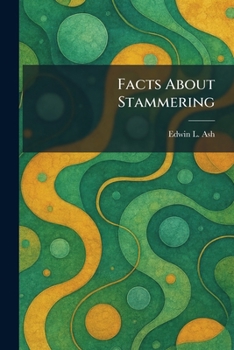
Facts About Stammering

"Facts About Stammering" is a practical and clinical exploration of speech impediments and their remedies, authored by Edwin L. Ash, M.D. This specialized medical work examines the various factors-both physical and psychological-that contribute to stammering, offering contemporary observations and guidance for those seeking to understand and overcome difficulties in verbal expression.
Drawing upon his extensive medical expertise, Dr. Ash discusses the mechanics of speech production, the influence of the nervous system, and the specific methods utilized in the early 20th century to treat stuttering in both children and adults. The text emphasizes the importance of mental confidence, rhythmic breathing, and systematic practice in achieving fluent speech and reducing the social anxiety often associated with vocal disorders.
As an important historical contribution to the field of speech pathology, "Facts About Stammering" provides an illuminating look into how communication disorders were classified and managed during the 1920s. It remains a significant resource for researchers, speech-language therapists, and historians interested in the evolution of communication therapies and the development of clinical psychology as it pertains to vocal health.
This work has been selected by scholars as being culturally important, and is part of the knowledge base of civilization as we know it. This work was reproduced from the original artifact, and remains as true to the original work as possible. Therefore, you may see the original copyright references, library stamps (as most of these works have been housed in our most important libraries around the world), and other notations in the work.
This work is in the public domain in the United States of America, and possibly other nations. Within the United States, you may freely copy and distribute this work, as no entity (individual or corporate) has a copyright on the body of the work.
As a reproduction of a historical artifact, this work may contain missing or blurred pages, poor pictures, errant marks, etc. Scholars believe, and we concur, that this work is important enough to be preserved, reproduced, and made generally available to the public. We appreciate your support of the preservation process, and thank you for being an important part of keeping this knowledge alive and relevant.
Customer Reviews
ThriftBooks ® and the ThriftBooks ® logo are registered trademarks of Thrift Books Global, LLC
