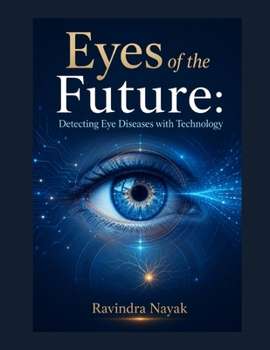
"Eyes of the Future: Detecting Eye Diseases with Technology"
No Customer Reviews

What happens when one of the most human parts of life-our ability to see-meets one of the fastest-moving areas of technology? Vision supports independence in ways we rarely notice: reading a face, crossing a street, learning, working, travelling, and moving confidently through an ordinary day. Yet several eye diseases can begin quietly, before a person recognizes how much is changing. At the same time, retinal imaging, optical coherence tomography, computer vision, and artificial intelligence are creating new ways to capture evidence, detect patterns, support screening, and connect people with care.
Eyes of the Future: Detecting Eye Diseases with Technology is a clear, human-centred guide for readers who want to understand this changing field without a medical degree, coding background, or fear of mathematics. Beginning with first principles, the book follows the complete journey from light entering the eye to an image being captured, checked, interpreted, converted into a risk signal, reviewed by people, and connected to a care decision. Through natural dialogues, visual learning maps, original reflections, and practical examples, the book explains common eye-disease stories, fundus photography, OCT scans, pixels, segmentation, labels, machine learning, sensitivity, specificity, calibration, thresholds, bias, privacy, explainability, teleophthalmology, human oversight, model updates, synthetic data, interoperability, and responsible scale. Technical ideas arrive only after the human purpose is clear, so each new layer has a place and a reason. This is not a diagnostic manual and it does not ask readers to trust technology blindly. It shows how to separate screening from diagnosis, prediction from care, confidence from certainty, and innovation from evidence. It also asks the questions that impressive demonstrations often leave unanswered: What happens when an image is poor? Who reviews an uncertain result? Does performance travel across populations and devices? Can a referral pathway handle the demand? How are consent, privacy, fairness, and accountability protected? The final Value Edition turns understanding into practice with a revision ladder, gentle mathematics, problem-chunking tools, evidence exercises, a project toolkit, a plain-language glossary, and a 30-day clear-thinking practice.
Written for curious readers, students, patients and families seeking general understanding, healthcare professionals entering digital eye care, program leaders, educators, and technology teams, this book offers a grounded way to understand eye disease detection technology-without hype, without unnecessary jargon, and without losing sight of the person behind the image.
Format:Paperback
Language:English
ISBN:B0CM5FYLH9
ISBN13:9798864737699
Release Date:October 2023
Publisher:Independently Published
Length:346 Pages
Weight:2.45 lbs.
Dimensions:0.9" x 8.5" x 11.0"
Customer Reviews
0 rating
Copyright © 2026 Thriftbooks.com
Terms of Use | Privacy Policy | Do Not Sell/Share My Personal Information | Cookie Notice | Cookie Preferences | Accessibility Statement
ThriftBooks ® and the ThriftBooks ® logo are registered trademarks of Thrift Books Global, LLC