


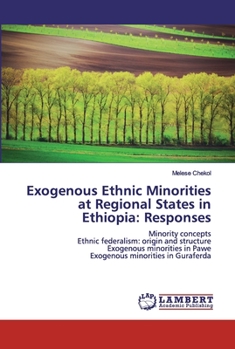
Exogenous Ethnic Minorities at Regional States in Ethiopia: Responses
No Customer Reviews

Ethiopia has adopted what is often referred to as ethnic federalism which aims to accommodate the ethnic diversity of the Ethiopian people principally, if not exclusively, through territorial mechanisms. It establishes nine ethnically demarcated regional states and provides the establishment of sub-regional territorial and political units for intra-regional ethnic minorities based on the same federal principle. Implied, or assumed to have been implied, in this federal arrangement is a notion of endogeneity in a sense only that only those ethnic communities that are viewed as endogenous to a specific territorial area are considered to be entitled for self-government either at regional or sub-regional level. This leaves out the millions who are considered to be exogenous without clear constitutional protection. A qualitative approach with purposive sampling techniques was employed during data collection. Interview, Focus group discussion and field observation was employed in this thesis. Among exogenous communities (not necessarily ethnic communities) in such constitutional quandary are those who moves to the areas now make parts such regions as Benishangul-Gumuz and SNNP.
Format:Paperback
Language:English
ISBN:620046040X
ISBN13:9786200460400
Release Date:October 2019
Publisher:LAP Lambert Academic Publishing
Length:100 Pages
Weight:0.35 lbs.
Dimensions:0.2" x 6.0" x 9.0"
Customer Reviews
0 rating
Copyright © 2026 Thriftbooks.com
Terms of Use | Privacy Policy | Do Not Sell/Share My Personal Information | Cookie Policy | Cookie Preferences | Accessibility Statement
ThriftBooks ® and the ThriftBooks ® logo are registered trademarks of Thrift Books Global, LLC
ThriftBooks ® and the ThriftBooks ® logo are registered trademarks of Thrift Books Global, LLC
